
FEATURED PHOTO: STAFFELMAUSER AND OTHER ADAPTIVE STRATEGIES FOR WING MOLT IN LARGER BIRDS
Article Sidebar
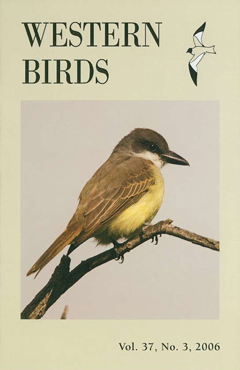
Published:
2006-07-01
Main Article Content
Abstract
The remiges (primaries and secondaries) of birds take a relatively long time to develop. Growth rates of primaries, for example, can vary from 3.2 mm per day in smaller birds to 6.3 mm per day in larger birds, but the summed lengths of all primaries can be as much as ten times greater in larger birds than in smaller birds (Rohwer 1999). Most passerines and other smaller birds replace all primaries sequentially from the innermost (p1) to the outermost (p9 or p10) and maintain the ability to fly, but most larger birds lack the time (between periods of breeding and migration) to follow this sequence within a single molt and have evolved alternative strategies.
Article Details
Issue
Section
Articles