
IDENTIFICATION AND MOLT STRATEGIES OF EASTERN AND WESTERN WARBLING-VIREOS
Article Sidebar
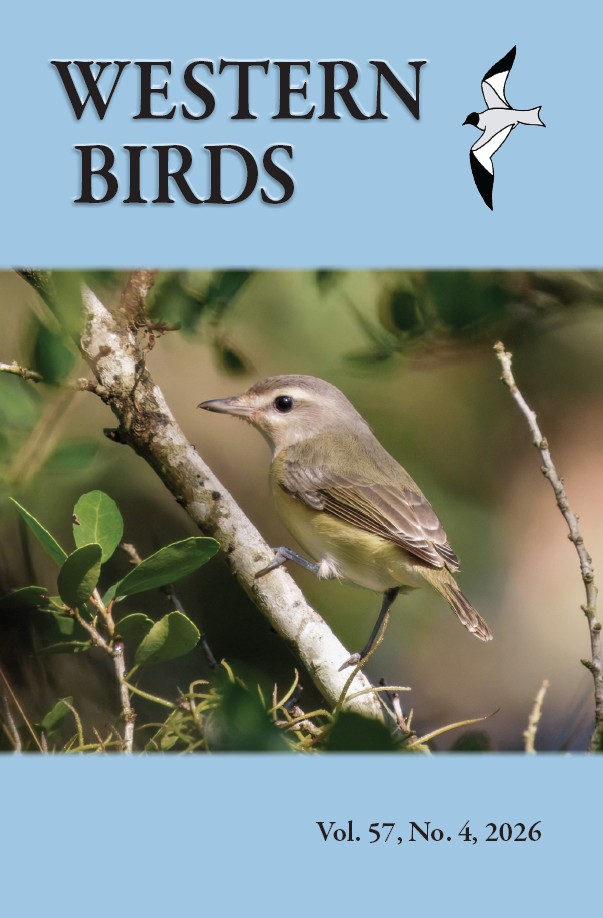
Main Article Content
Abstract
The reclassification of the Eastern (Vireo gilvus) and Western (V. swainsoni) Warbling-Vireos as separate species has stimulated interest in their identification. We examined photographs of 85 Easterns and 89 Westerns in the Cornell Lab of Ornithology’s Macaulay Library, finding the ratio of the distance between the tips of primaries 6 and 5 to that between the tips of p5 and p4, the “p6:5 ratio,” to be the most useful difference. A p6:5 ratio >0.90 eliminates 95% of Westerns and includes 68% of Easterns, whereas a ratio <0.73 eliminates 95% of Easterns and includes 52% of Westerns. Our results support previous reports that the Eastern molts primarily on its summer grounds, before southbound migration, but are counter to reports that all Westerns migrate before molt: 36% of adults and 39% of first-fall birds had molted or commenced molt within the breeding range. Thus retention of worn plumage in adults and juvenile greater coverts in first-year birds suggests a Western, whereas replacement of these feathers does not distinguish the species. Prealternate molt is more extensive in the Eastern than the Western, aiding identification in spring. Applying our findings to records of vagrants, we identified 12 Westerns from east of the Mississippi River and in South America and six Easterns from Alaska, Arizona, California, and the Azores that appear to represent vagrants. Distinguishing many, but not all, Eastern and Western Warbling-Vireos is possible with high-quality images in which the spacing of primaries, facial markings, molt state, and/or side coloration can be assessed.
Article Details
Section

This work is licensed under a Creative Commons Attribution-NonCommercial-ShareAlike 4.0 International License.