Skip to main navigation menu Skip to main content Skip to site footer

Volume 50, No. 4

Published October 1, 2019

Issue description

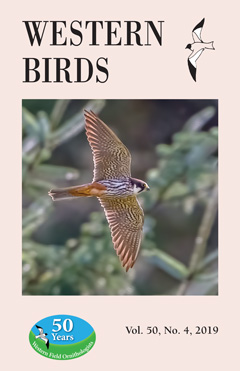
Volume 50, number 4 of Western Birds, published 2019

Articles

  1. ELEVENTH REPORT OF THE WASHINGTON BIRD RECORDS COMMITTEE (2014–2016)

     Since its tenth report (Mlodinow and Bartels 2016) the Washington Bird Records Committee has reviewed 318 reports representing 98 species and six subspecies. A total of 225 reports were endorsed, an acceptance rate of 72%. Eight species and one subspecies were added to the Washington state checklist: the Broadbilled Hummingbird (Cynanthus latirostris), Spotted Redshank (Tringa erythropus), Least Auklet (Aethia pusilla), Woodhouse’s Scrub-Jay (Aphelocoma woodhouseii), Red-flnked Bluetail (Tarsiger cyanurus), Gray Wagtail (Motacilla cinerea), Little Bunting (Emberiza pusilla), Lucy’s Warbler (Oreothlypis luciae), and the Siberian subspecies of the American Pipit (Anthus rubescens japonicus). In addition, the decision to treat the Iceland (Larus glaucoides sensu stricto) and Thayer’s (L. thayeri) gulls as a single species, under the name of Iceland Gull (L. glaucoides sensu lato), reduced the state bird list by one. The Washington state list now stands at 514 species.

  2. SPATIOTEMPORAL PATTERNS OF THE CALIFORNIA SPOTTED OWL’S TERRITORIAL VOCALIZATIONS

     Emerging bioacoustic technology allows researchers to passively record animal vocalizations to study population dynamics at relatively broad spatial scales. Spatiotemporal patterns in vocalization behavior free from direct human inflence, which occurs during traditional vocal-lure surveys, may also yield novel behavioral insights. We used passively recorded audio data to examine such patterns in the California Spotted Owl (Strix occidentalis occidentalis) across the northern Sierra Nevada. We assessed temporal patterns in the initiation of bouts of four-note calls and the number of such calls, and we used generalized linear mixed models to test whether environmental factors inflenced bout-initiation time, bout duration, and the number of calls per unit time. We found that (1) Spotted Owls were most vocally
    active within three hours of sunset, (2) bouts of calling were longer with fewer calls per unit time in open and young forest, (3) those bouts were concentrated in the middle of the night, and (4) the frequency of occurrence and duration of bouts of territorial vocal activity was reduced in montane riparian forest. These patterns suggest that Spotted Owls may engage in territorial defense in marginal habitat (open and young forest) and minimize their vocal activity in key foraging habitat (montane riparian forest). This application of acoustic monitoring data to behavioral ecology illustrates the broad applicability of the underlying audio data and its potential to yield novel ecological insights.

  3. ACORN DISPERSAL BY CALIFORNIA SCRUB-JAYS IN URBAN SACRAMENTO, CALIFORNIA

     California Scrub-Jays (Aphelocoma californica) harvest and cache acorns as a fall and winter food resource. In 2017 and 2018, I studied acorn caching by urban scrub-jays in Sacramento, California, to characterize oak and acorn resources, distances jays transport acorns, caching’s effects on the jay’s territoriality, numbers of jays using acorn sources, and numbers of acorns distributed by jays. Within four
    study areas, oak canopy cover was <1%, and only 19% of 126 oak trees, 92% of which were coast live oaks (Quercus agrifolia), produced acorns. Jays transported acorns for ≥117 days. Complete (28%) and partially recorded (72%) flghts from acorn sources to caching sites averaged 160 m and ranged up to 670 m. Acorntransporting jays passed at tree-top level above other jays’ territories without eliciting defense. At least 20 scrub-jays used one acorn source in one 17.5-ha area, and ≥13 jays used another 4.7-ha area. Jays cached an estimated 6800 and 11,000 acorns at two study sites (mean 340 and 840 acorns per jay, respectively), a rate much lower than reported in California oak woodlands, where harvest and caching are confied within territories. The lower urban caching rate may result from a scarcity of acorns,
    the time required for transporting longer distances, and the availability of alternative urban foods. Oaks originating from acorns planted by jays benefi diverse wildlife and augment the urban forest.

  4. A QUANTITATIVE STUDY OF NASAL BRISTLE LENGTH IN THE COMMON AND CHIHUAHUAN RAVENS

     the proportionately longer nasal bristles of the Chihuahuan raven (Corvus cryptoleucus) have been adduced as a character distinguishing that species from the Common raven (C. corax). in a sample of 113 specimens of the Common raven and 86 of the Chihuahuan we confimed that the average of the bristle-to-bill ratio differs signifiantly in the two species, being 26% greater in the Chihuahuan. But
    the overlap is wide: only 36% of the Chihuahuan ravens and 22% of the Common ravens fell outside the zone of overlap. on the basis of this character, only ravens with a ratio <0.45 can be identifid as the Common, while those with a ratio >0.60 are almost all Chihuahuan.

  5. PEREGRINE FALCON DELIVERS FISH TO FLEDGLING IN NORTHERN NEW MEXICO

     The Peregrine Falcon (Falco peregrinus) is well known as a predator of aerial prey. White et al. (2002) estimated that the diversity of birds it captures exceeds 2000 species worldwide. Its primary mammalian prey are also aerialists: bats. In North America, recorded prey encompass at least 429 species of birds and 23 of mammals, including 10 of bats (White et al. 2002). Fish would not appear to be available as food for aerial hunting Peregrines. Nevertheless, Cade (1960) reported an incident of capture of live fih: his visit to an Alaska eyrie had agitated the adults, which circled above him, calling. The male then stooped and captured an arctic grayling (Thymallus arcticus) from a school leaping from the nearby river and transferred it to his mate, who departed the immediate area, apparently because of the human presence. In California, Peregrines have been seen pirating fih from Ospreys (Pandion haliaetus) (B. Walton in White et al. 2002). Our Figure 1 represents what we believe is the fist photo-documentation of a Peregrine Falcon feeding on a fih.

  6. FATAL INTERACTION OF MARBLED GODWIT WITH RIBBED MUSSEL

     The Marbled Godwit (Limosa fedoa) is a large shorebird that breeds in the grasslands of the north-central United States and south-central Canada, with small and isolated nesting populations along the southwest shore of James Bay, Canada, and on the Alaska Peninsula (Gratto-Trevor 2000). It migrates principally to the west coast of North America, wintering mainly from Washington to El Salvador, including the Baja California Peninsula (Gratto-Trevor 2000). Independently of any annual variation in numbers, the Marbled Godwit is common at Estero Punta Banda, with numbers estimated from many hundred (Jiménez et al. 2009) to nearly 2500 (Palacios et al. 1991) individuals.

  7. BOOK REVIEW: Gulls of the world: A Photographic Guide

     At last, larophiles have a portable guide to all the world’s gulls. Recent guides to this subfamily covered only the Northern Hemisphere (Malling Olsen and Larsson 2003, 2004) or the Western Hemisphere (Howell and Dunn 2007). Another recent treatment of identification of the world’s gulls (Burger and Gochfeld 1996), in volume 3 of del Hoyo et al. (1992–2013), was necessarily brief and contained in a volume weighing 4.5 kg, hardly appropriate for field use.

  8. FIRST NORTH AMERICAN NESTS AND EGGS OF THE LITTLE STINT

     The Little Stint (Calidris minuta) commonly breeds in the high Arctic tundra of Eurasia from northern Scandinavia east to central Siberia; it is an uncommon and irregular breeder east of the Indigirka River (150° E) to the Bering Strait (Tomkovich 1996, Lappo et al. 2012). In Alaska, Gibson and Withrow (2015) described the species as a casual visitant (documented in <30% of years) to the north, west, and southwest regions of the state. Of the Little Stints recorded from Alaska, 11 have occurred from 15 June to 15 July (Gibson and Kessel 1992, Iliff and Sullivan 2004; checklists #S40242942, #S17187097, #S30264527, #S30595446, #S37636130, #S46578403 at www.eBird.org), the period when Little Stints typically breed (Haviland 1915, Hildén 1983, Underhill et al. 1993). Eight of these records are from the Arctic Coastal Plain of northern Alaska (Table 1). Although the observation of a displaying bird suggests that the species has attempted to breed there in the past, breeding in Alaska and in North America has never been confimed (Iliff and Sullivan 2004; Table 1).

  9. THANKS TO WESTERN BIRDS’ REVIEWERS AND ASSOCIATE EDITORS

     Peer review is a critical step in the publication of a scientific journal. I thank the following people for their generosity in taking the time to provide this essential service sustaining the scientific quality of Western Birds for volume 50