EDWARD R. PANDOLFINO, RICHARD W. HEDLEY
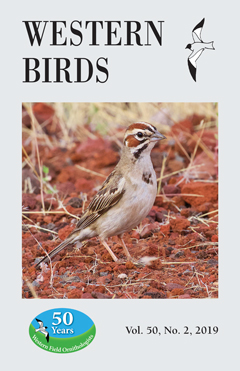
We studied the song of the lark Sparrow (Chondestes grammacus) in recordings of 15 individuals from a variety of locations in California. lark Sparrow song is delivered as variable sequences structured in a hierarchy of four levels: elements, syllables, strophes, and themes. at the simplest level, elements can be distinguished by their appearance on a spectrogram. Birds vary the number of repetitions of each element to produce a syllable and string together several syllables to produce a strophe (mean 5.9 syllables per strophe). Strophes are delivered at an average rate of 5.4 per minute. Strophes can be further classifid as belonging to one of a few themes in a male’s repertoire, where strophes in different themes are composed of almost entirely distinct elements and syllables. in <6% of strophes did we fid elements from one theme mixed with elements from a different theme. Each individual sang one to three themes. The size of the repertoire of strophes is large but we could not quantify it because within a continuous bout of singing any particular sequence of syllables was repeated in only 5% of strophes. Each theme comprised roughly 20–40 distinct syllables. Thus an individual singing three themes could have a repertoire of 60–120 syllables. The number of unique elements per theme ranged from 11 in birds revealing just one theme up to 39 in birds revealing three themes, but longer recordings may have yielded more elements per bird. if our observations for single-themed birds may be extrapolated, birds with three themes might have repertoires of 33–51 elements. in the two comparisons possible, we detected almost no sharing of elements among neighboring birds.
58-73
BRIAN M. MYERS, ERIN J. QUESTAD, MARCUS D. HUBBELL, DAVID J. MORIARTY
Climate change is predicted to exacerbate the effects of disturbances such as drought on numerous wildlife communities. on the basis of surveys from 1981 to 2014, we investigated whether drought altered the species richness and composition of bird communities of coastal sage scrub in two protected areas of southern California. at one site, the voorhis ecological reserve, Pomona, we found that the number of species of permanent residents, but not of summer and winter visitors, was lower during droughts than during periods of at least average rainfall. at the other site, the Bernard Field station, Claremont, we found that the richness of resident species remained the same in both drought and nondrought periods, and richness of summer and winter visitors increased during times of drought. the difference in patterns
between these sites may be explained by the presence of a constructed, permanent water source at the second site. thus, supplemental water sources embedded in natural areas might be an important resource for native bird species during drought.
74-91
ALISHA RITCHIE, MYRNA PEARMAN
All three species of North American bluebirds are secondary cavity nesters that readily accept nest boxes. Typically, all three are socially monogamous, with a single male and a single female defending a territory against intruding conspecifis and alone raising their offspring (Guinan et al. 2008, Gowaty and Plissner 2015, Johnson and Dawson in press). Both parents provision nestlings for 17–22 days, and the young continue to rely on the parents for protection and food for several weeks post-fldging (Guinan et al. 2008, Gowaty and Plissner 2015, Johnson and Dawson in press). Pairs that raise a fist brood early enough in the season usually make a second attempt (Guinan et al. 2008, Gowaty and Plissner 2015, Johnson and Dawson in press).
92-97
JORDAN C. GIESE, JARED D. HALL, HEATHER A. MATHEWSON
Along the lower Rio Grande in Texas, an estimated 95% of native vegetation has been destroyed through urban and agricultural expansion, leaving only isolated remnants of once continuous woodland (Jahrsdoerfer and Leslie 1988). Although some bird species have declined because of habitat loss and alteration, other species have increased. In recent decades, the Clay-colored Thrush (Turdus grayi) has expanded its range north into south Texas and is now considered common in the lower Rio Grande valley (Brush and Conway 2012), a subtropical region comprising the state’s four southernmost counties.
298-100
MICHAEL ACADEMIA
The Osprey (Pandion haliaetus), with a nearly worldwide breeding distribution and a tolerance for both fresh and salt water, feeds almost exclusively (99+%) on fih (Grove et al. 2009). The availability of prey is an important factor inflencing its productivity (Van daele and Van daele 1982, harmata et al. 2007). Time spent on foraging is a function of prey availability, and success in breeding may be related to food provisioning (dykstra 1995) as well as the food supply (croxall et al. 1988). Under favorable conditions, provisioning rates are elevated, and birds fully meet their own energetic requirements and those of their chicks (cairns 1987, Weimerskirch 1998). Proximate causes of nest failure include bad weather, avian and nonavian competitors, and predation, as well as insuffiient care by inexperienced parents. if
the weather is bad, the adults may be unable to forage (hudson 1985). however, the ultimate cause of nest failure may often be food shortage (Steenhof and Newton 2007); for example, a female unable to provision her chicks abandons her brood, which is then vulnerable to predation.
101-106
EDWARD R. PANDOLFINO
Like many of you, I have bookshelves overflwing with all sorts of bird books—to the point where I have adopted a personal policy of buying a new one only if it replaces one I have, or if it represents a unique contribution. When Nathan Pieplow’s earlier eastern version of this guide appeared, there was no question that it met the second requirement. That book sits within arm’s reach of my desk. Living in the West, however, I have been eagerly awaiting the completion of the set with the publication of a western version.
106-107
Teresa Ely
Raptors can be a challenge to identify, particularly because of their variability, but with practice it becomes easier and clearer. Numerous identifiation guides are available for the raptor enthusiast, hawk watcher, or biologist to use in the fild, as a reference on a library shelf, or now as an app on a smart phone. The new Birds of Prey of the West is a complement and update to Wheeler’s 2003 book Raptors
of Western North America, now out of print (reviewed by David Lukas in Western Birds 34:252–253, 2003). At fist glance, this new version has the feeling of a standard fild guide, but deeper reading reveals that this is a fild guide for the advanced raptor enthusiast.
107-109
Daniel D. Gibson
I n his inimitable style—articulate, eclectic, and thoroughly readable—Ted Floyd unfolds the stages, events, and epiphanies of a lifelong interest in bird study. Two hundred epistles organized in six chapters are arranged by season of the year and growing length and depth of experience: January–February, “Spark Bird”; March–May, “After The Spark”; June–July, “Now What?”; August–September, “Inflction Point”; October–November, “What We Know”; and December, “What We Don’t Know.” In a baker’s dozen examples chosen almost at random, these chapters include subjects such as (16) If It Walks Like a Duck, (17) A Colorless, Shapeless, Amazing Bird, (22) The Value of Local Experience, (33) Do the Checklist Shuffl, (40) The Absolute Best Way to Learn Birdsong, (62) The Logic of Migration: A Tale of Two Teals, (83) Whither the Field Notebook?, (119) What Is Molt Anyway?, (121) Two for The Price of One, (161) On The Origins of Knowledge: Bird Banding, (164) On the Origins of Knowledge: Scientifi Collecting, (177) Schrödinger’s Hawk, and (200) Who Knew? You cannot go wrong here. I think that anyone’s interest in bird study will only be enhanced, and often clarifid, by reading this book. And John Schmitt’s handsome illustrations punctuate the work at every turn. <br class="Apple-interchang
110