ERIC A. VANDERWERF, REGINALD E. DAVID, PETER DONALDSON, RICHARD MAY, H. DOUGLAS PRATT, PETER PYLE, LANCE TANINO
The Hawaii Bird Records Committee (HBRC) was formed in 2014 to provide a formal venue for reviewing bird reports in the Hawaiian Islands and to maintain and periodically update the checklist of birds of the Hawaiian Islands. This is the fist report of the HBRC. From 2014 to 2016, the HBRC reviewed 46 reports involving 33 species, including 20 species not recorded previously in the Hawaiian Islands, nine species reported previously that were based only on visual documentation at the time, one re-evaluation of a species pair reported previously, two introduced species whose establishment was questioned, and one species previously regarded as hypothetical. The HBRC accepted 17 new species, did not accept three new species, and did not accept fie species that previously had been accepted on other checklists of Hawaiian Island birds. The Hawaiian Islands bird checklist includes 338 species accepted through 2016.
2-23
ADAM J. SEARCY, BRIAN E. DANIELS, JONATHAN S. FEENSTRA, JAMES R. TIETZ, THOMAS A. BENSON
The California Bird Records Committee reached decisions on 185 records involving 192 individuals of 80 species and three species groups (Singer et al. 2016), endorsing 151 records of 157 individuals. The fist accepted state records of the Common Scoter (Melanitta nigra) and Kelp Gull (Larus dominicanus) are outlined in this report, bringing California’s total list of accepted species to 663, of which 11 are established introductions. Other notable records detailed in this report include the state’s second of Tristram’s Storm-Petrel (Oceanodroma tristrami) and Couch’s Kingbird (Tyrannus couchii), third and fourth of the Nazca Booby (Sula granti), fourth of the White-chinned Petrel (Procellaria aequinoctialis) and Bridled Tern (Onychoprion anaethetus), and sixth and seventh of the Varied Bunting (Passerina versicolor).
24-46
REBECCA G. CHEEK, KYLE K. CAMPBELL, KEVIN WINKER, ROBERT W. DICKERMAN, BERRY WIJDEVEN
Genetic studies of subspecies endemic to Haida Gwaii (Queen Charlotte Islands) in British Columbia and the Alexander Archipelago of southeast Alaska have frequently found patterns of genetic differentiation corresponding to these phenotypically based taxa. Divergence and speciation are common among island populations of birds, and evidence suggests this region has fostered such divergence during previous glacial maxima. We examined divergence in the mitochondrial gene for NADH dehydrogenase subunit 2 (ND2, a marker used in other studies of regional endemism) in two additional coastal subspecies endemic to this region, of the Sharp-shinned Hawk (Accipiter striatus perobscurus) and Great Blue Heron (Ardea herodias fannini). In both the hawk and heron genetic diversity in ND2 was
remarkably low in contrast to that in mitochondrial genes in other species with regional endemics. In both Accipiter striatus perobscurus and Ardea herodias fannini we found only the haplotype most common in continental populations. We found low but signifiant divergence in frequencies of haplotypes of ND2 between A. s. perobscurus and continental populations of the Sharp-shinned Hawk and no signifiant population divergence in the Great Blue Heron. In contrast with other regional endemics that do show signals of having persisted through at least one past Ice Age in an unglaciated refugium, these subspecies may have arisen relatively recently, with their adaptation to the local environment leading to darker coloration paralleling that of the region’s older endemics. Alternatively, species-wide selective sweeps of mitochondrial DNA prior to divergence of these taxa may have rendered this genetic marker less useful for tracking divergence arising in a refugium.
47-61
RODNEY B. SIEGEL, PETER PYLE, HELEN L. LOFFLAND
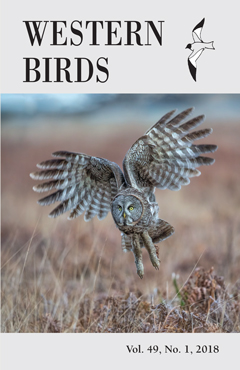
in California, the great gray owl (Strix nebulosa) has a very small population and is considered endangered. the Coast Range of northwestern California is not considered part of the species’ regular range, and prior to January 2016 there were only three records for the region. during the winters of 2015–2016 and 2016–2017, however, a great gray owl occurred in Humboldt County at locations separated by about 50 km. We evaluated photographs from both winters to assess whether they were of the same individual owl. Patterns of retained juvenile wing feathers and replaced feathers of the defiitive basic plumage were consistent with the owl photographed in winter 2016–2017 (likely in its fourth cycle) being one year older than the one photographed in winter 2015–2016 (likely in its third cycle). furthermore, during both years, the same primary feather on the right wing showed an irregularity along the inner web near the tip, including a notch and additional damage to the barbs, evidence that the observations in both years were of the same individual. feather-replacement patterns in this individual during these two winters, along with those of another specimen from Humboldt County from 2007, imply that the sequences of molt of the remiges in the great gray owl parallel those of other Strix but that the rate of molt may be slower than previously reported.
62-73
DEVEN KAMMERICHS-BERKE
On the morning of 1 May 2016, while monitoring Western Snowy Plover (Charadrius nivosus nivosus) breeding activity on the south spit of Humboldt Bay (40.741° N, 124.245° W), I found a storm-petrel carcass on the high waveslope. At Humboldt State University, Tamar Danufsky and I later identifid it as a Wedge-rumped StormPetrel (Oceanodroma tethys), a neotropical species typically found offshore from Baja California Sur to northern Chile. Housed at Humboldt State University (HSU 9649), this specimen, the second for California, represents the 13th record for California accepted by the California Bird Records Committee (Tietz and McCaskie 2017) and the northernmost record of the species.
74-76
MARIE P. MORIN, ANDRÉ F. RAINE, EMILY HABER, ROBERT Z. TORRES
The Tahiti Petrel, Pterodroma rostrata (Chesser et al. 2011) or Pseudobulweria rostrata (Bretagnolle et al. 1998, Birdlife International 2012, Howell 2012, Dickinson and Remsen 2013), breeds in the Society and Marquesas islands, New Caledonia, and other islands in the South Pacifi Ocean (Villard et al. 2006). It ranges widely in the tropical central Pacifi and is considered a nonbreeding vagrant in Hawaiian waters (Pyle and Pyle 2017). Three of this species’ close relatives of the genus Pseudobulweria are “critically endangered,” and the Tahiti Petrel itself is listed as “near threatened” on the Red List of the International Union for Conservation of Nature (Birdlife International 2012). The Tahiti Petrel is very similar in appearance to the endangered Phoenix Petrel (Pterodroma alba), which has made it diffiult to establish the Tahiti Petrel’s distribution in the north-central Pacifi (King 1970, Spear et al. 1992, 1999, Spear and Ainley 1998, BirdLife International 2016). Early unsubstantiated sight reports of Phoenix or Tahiti Petrels near the Hawaiian Islands include four birds seen during cruises by the U.S. Fish and Wildlife Service in 1964 and 1965 (King 1970) and one or two Tahiti Petrels seen southeast of Hawai’i Island on 5 November 1984 (Spear et al. 1999). The fist Tahiti Petrel record accepted by the American Ornithologists’ Union for North America was based on photographs taken in 2009 off Costa Rica (Obando-Calderon et al. 2010, Chesser et al. 2011). Because of identifiation diffiulties in the fild, the Tahiti Petrel had been previously identifid in Hawaiian waters with the Phoenix Petrel as part of a “species pair” (King 1970, AOU 1998, Pyle 2002).
77-81
CARL W. BROWN, SUSAN PATLA, RICHARD E. JOHNSON
The Black Rosy-Finch (Leucosticte atrata) is one of the least studied bird species in North America, owing to its nesting in high alpine habitat, predominantly in cliffs (Johnson 2002). It breeds in low densities from west-central Montana/northeastern Idaho east to northwestern Wyoming, south to southern Utah, and west to northeastern Nevada/southeastern Oregon (Johnson 2002). It nests in most contiguous mountain ranges of northwestern Wyoming: the Wind River Range (Cary 1917), the Absaroka Range (Miller 1925), the Gallatin Range (Bailey 1930), the Gros Ventre Range (Fuller and Bole 1930), the Teton Range (French 1954), and the Beartooth Mountains (Hoffmann and Taber 1960) (Figure 1). The Black Rosy-Finch is known to occur in the isolated Bighorn Mountains (see Johnson 2002, Faulkner 2010), where reported incorrectly as the Brown-capped Rosy-Finch (L. australis) by Carpenter (1876) and as the Gray-crowned Rosy-Finch (L. tephrocotis) beginning with Grave and Walker (1913), an error corrected by Mengel and Mengel (1952). We here report Black Rosy-Finches breeding in the Wyoming Range (observed by Johnson in 2002 and Brown in 2015) and in the Salt River and Snake River ranges (observed by Brown in 2015) (Figure 1), where no previous nesting records are known. These mountain ranges are clustered and abut others where the species is known to breed. The inclusion of the Salt, Snake River, and Wyoming ranges bridges the gap, where suitable habitat is available, in the Black Rosy-Finch’s distribution between northwestern Wyoming and northeastern Utah. We also observed nesting pairs within the species’ previously documented distribution.
82-85
ANTHONY MENDOZA
I report on the effects of a total solar eclipse on calling birds at Market Lake Wildlife Management Area just north of Roberts, Idaho, on 21 August 2017. Market Marsh Wildlife Management Area (43.780° n, 112.194° W) was established in 1956 to restore the natural marshes around Market Lake, and consists of a system of levees separating marsh and open water. It covers 2052 hectares and is managed by the Idaho department of Fish and Game. on 21 August 2017, the partial eclipse at this site started at 10:15 Mountain daylight time, totality started at 11:32 and ended at 11:34, and the partial eclipse ended at 12:57 www.timeanddate.com/ eclipse/map/2017-august-21#). the national Weather Service measured the high for the day in nearby Idaho Falls at 28° C (http://w2.weather.gov/climate/index. php?wfo=pih), and the temperature dropped 7.2° C just before and during totality (local measurement).
86-88
Blake A. Grisham
Within the past two decades, the discipline of wildlife conservation has seen a surge in ecological-modeling approaches that has profoundly affected the way we perceive animals and ecological processes. One negative outcome of our own technological advances has been the shift in focus from observations of animals in the fild to collecting data to fi ecological models. Although modeling does have its place in biology, animal behavior is a thing of inexplicable beauty and timelessness, and has intrinsic value well beyond our own interest as conservationists. In Those of the Gray Wind: The Sandhill Crane, Paul A. Johnsgard successfully describes the chronology of migration and other behaviors of the Sandhill Crane by creating a sense of wonder for the species via the sights and sounds witnessed by fitional human characters. The book is an excellent summary of the folklore of the Sandhill Crane, how its unique behaviors fascinate humanity, and the ecology of the species throughout its life cycle. Those of the Gray Wind was originally published in 1981 (St. Martin’s Press), and this new edition includes a new preface and afterword by the author. The preface is an excellent start because it highlights the author’s motivation behind the book, which is another story about one man’s fascination with cranes (consider it the book’s fial, contemporary chapter). The afterword includes scientifi data about crane populations in North America, including population trends, conservation needs, and long-term concerns, and emphasizes the author’s expertise on the species.
89-90
WFO’s members responded impressively to our efforts at fund-raising in 2017. The board of Western Field Ornithologists and the editorial team of Western Birds thank the following contributors for their extraordinary generosity in 2017
91-92
KRISTIE NELSON
Bill deformities in wild birds are normally very rare, so when concentrations of Black-capped Chickadees (Poecile atricapillus) and Northwestern Crows (Corvus caurinus) with malformed bills were detected in Alaska in the late 1990s and early 2000s, citizens and researchers became alarmed. An epizootic of bill deformities was documented and described as an emerging avian disease, coined “avian keratin disorder” (AKD) (Handel et al. 2010). Birds with this disorder had elongated, twisted bills caused by accelerated production of keratin in the rhamphotheca, the outer layer of a bird’s bill (Van Hemert et al. 2012b). Between 1999 and 2008, studies revealed that 6.5% of Alaska Black-capped Chickadees had bill deformities characteristic of AKD (Handel et al. 2010), and in 2007 and 2008 the prevalence of AKD in Alaska populations of the Northwestern Crow averaged nearly 17%, ranging as high as 36% in the Kenai Peninsula (Van Hemert and Handel 2010). These were by far the highest rates of bill deformities reported in wild bird populations. Although chickadees and corvids have had the largest number of reported cases, woodpeckers, nuthatches, and an increasingly wide variety of other species have also been affected (Handel et al. 2010, C. Van Hemert pers. comm.). Signifiant outbreaks of AKD-like deformities have also been reported in the United Kingdom, affecting similar taxa (www.bto.org/ volunteer-surveys/gbw/about/background/projects/bgbw). Afflcted birds become handicapped in their ability to accomplish essential activities such as feeding and preening, and mortality rates appear high (Van Hemert et al. 2012a, Van Hemert et al. 2012b, Handel et al. 2010).
93-95