WALTER WEHTJE, HARTMUT S. WALTER, RICARDO RODRIGUEZ ESTRELLA, JORGE LLINAS, ARADIT CASTELLANOS VERA
In recent years, ornithologists have devoted increased attention to insular avifaunas and the problems they face (Scott et al. 1986). Many island species are critically endangered and require human intervention in order to survive. Island species also provide the opportunity to test differing ecological and biogeographical theories (MacArthur and Wilson 1967, Jones and Diamond 1976). However, many remote islands are not visited frequently enough or for periods long enough to provide information on population trends and the loss and/or gain of breeding species. Such has been the case for the Islas Revillagigedo off Mexico (Figure 1).
1-16
KATHLEEN E. FRANZREB, STEPHEN A. LAYMON
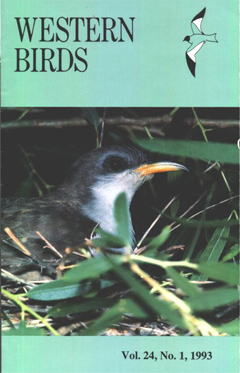
Two North American subspecies of the Yellow-billed Cuckoo (Coccyzus americanus) have been defined by a difference in size: a smaller eastern (C. a. americanus) and a larger western (C. a. occidentalis). This taxonomic treatment was proposed originally by Ridgway (1887) and later followed by other workers (Peters 1940, A.O.U. 1957, Oberholser 1974), though various authors have questioned the validity of this separation (Todd and Carriker 1922, Van Tyne and Sutton 1937, Mees 1970, Banks 1988).
17-28
ERIC MELLINK, EDUARDO PALACIOS
Although several researchers have studied birds in the state of Sonora, Mexico, few published reports exist. Van Rossem (1945) published the only comprehensive summary, now outdated. Recently, Everett and Anderson (1991) addressed the status of the breeding seabirds of the Gulf of California.
The northernmost of Sonora’s large lagoons is Bahía San Jorge, with its associated Estero San Francisquito and islands (Figure 1). Bahía San Jorge is a large bay separated from the open gulf by a long (10 km) sand bar on its southern side. Estero San Francisquito, a long, narrow tidal estuary, lies immediately to the south. Except for marshes inside the southern part of the bay, dunes are the principal terrestrial habitats around Bahía San Jorge. Certain areas are open flats with shell debris. Bahía San Jorge and Estero San Francisquito have not been investigated ornithologically in any detail, like the rest of the northern Sonora coast, with the exception of Puerto Peñasco, a popular destination for North American birdwatchers, reported on by Huey (1935) and Janes and Janes (1987).
29-37
EVELYN L. BULL, JANET E. HOHMANN
The Vaux’s Swift (Chaetura vauxi) is a neotropical migrant that visits the Pacific Northwest long enough to nest and then returns to warmer climates for the winter. The interest in this species is two-fold. First, in the eastern United States neotropical migrants have undergone a general population decline that may be related to deforestation, habitat degradation, and forest fragmentation. Because the Vaux’s Swift nests primarily in large hollow trees (Taylor 1905, Baldwin and Zaczkowski 1963, Bull and Cooper 1991), it could be affected by these factors. Second, in the Washington Cascade Range this species seems to be associated with old growth in Douglas-fir (Pseudotsuga menziesii) forests (Manuwal and Huff 1987), which is rapidly being logged. Our objective in this study was to determine if Vaux’s Swifts are positively associated with old-growth forests in northeastern Oregon.
38-42
JULIE A. R. ALBERICO
The Lahontan Valley wetlands of Nevada are critical breeding, wintering, and migratory stopover sites for shorebirds and waterfowl and have been classified as a Hemispheric Reserve within the Western Hemisphere Shorebird Reserve Network (Myers et al. 1987, Harrington et al. 1989). From 1905 through 1987, wetlands in the Lahontan Valley declined from 34,800 to 6150 ha (Hoffman et al. 1990:5). In 1991, these wetlands were reduced further as Nevada experienced its fifth consecutive year of drought (Schaefer 1991). During 1991, I monitored breeding by American Avocets (Recurvirostra americana) and Black-necked Stilts (Himantopus mexicanus) in the extremely limited suitable habitat available to them in the Lahontan Valley. Here I report numbers of breeding recurvirostrids and discuss possible reasons for their success or failure in 1991.
Avocets and stilts feed in shallow wetlands and nest together in loose colonies (Hamilton 1975). Neighboring pairs work together in voicing alarm, mobbing potential predators, and performing distraction displays (Sordahl 1986, 1990). Like the well-studied Pied Avocet (R. avosetta) in Europe and Black Stilt (H. novaezelandiae) in New Zealand, they probably first breed at an age of 2 or 3 years and are relatively long-lived (Cadbury and Olney 1978, Christine Reed pers. comm.). Sordahl (1984) marked individual American Avocets and Black-necked Stilts and observed 20–30% return in the following breeding season; 60–90% of these birds had previously bred successfully.
43-52
PETER PYLE, STEVE N. G. HOWELL
On 12 October 1991 we discovered an Arctic Warbler (Phylloscopus borealis) on Punta Eugenia, west of Guerrero Negro, Baja California. This sighting constitutes the first record of this primarily Old World species from Mexico and from North America south of Alaska.
53-56
STEVE N. G. HOWELL, PETER PYLE
From 9 to 16 October 1991 we visited Baja California, south to Punta Eugenia in northern Baja California Sur. During this period we encountered several notable species, including five previously unreported from the peninsula. Our most surprising discovery was of an Arctic Warbler (Phylloscopus borealis) at a remote desert ranch; we have detailed this remarkable record in another note in this issue (Pyle and Howell 1993). Here we discuss other species of interest seen on this trip.
57-62
Robert McKernan
The seventeenth annual meeting of the Western Field Ornithologists was held jointly with the San Francisco Bay Bird Observatory from 18 through 20 September 1992 at the Holiday Inn in Sunnyvale, California. The annual meeting was a great success, with boat trips out of Monterey Bay (Streaked Shearwater!), field trips in the San Francisco Bay Area (Garganey, Ruff, etc.!), a well-prepared and excellent paper session, and a lively panel discussion of identification problems, not to mention a fine barbecue and banquet. The San Francisco Bay Bird Observatory was the host for the annual meeting, and its organization of the meeting was exceptional and very professional. One person who deserves special credit is Janet Hanson, who kept all things running smoothly. Thanks, Janet.
63-63