GUY McCASKIE, MICHAEL A. PATTEN
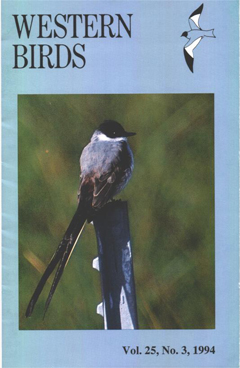
The Fork-tailed Flycatcher (Tyrannus savana) breeds in Middle and South America and occurs in North America as a vagrant. Monroe and Barron (1980) summarized 40 reports of Fork-tailed Flycatchers in the United States and Canada and concluded that "North American vagrants... have been presumed to be vagrants that 'overshot' their normal 'wintering' grounds in northern South America." While they noted some movements that did not fit this pattern, they offered no hypothesis to explain them.
113-127
ROBERT W. DICKERMAN, JOHN P. HUBBARD
The Sharp-tailed Grouse (Tympanuchus phasianellus Linnaeus) reached the southern limits of its historic range in northeastern New Mexico, where a population occupied Johnson and adjacent mesas in Colfax and perhaps Union counties (Ligon 1927, Bailey 1928).
Since first reported, the New Mexico population has been variously assigned to the prairie subspecies T. p. campestris(Ridgway), the Columbian T. p. columbianus (Ord), or the high-plains form T. p. jamesi (Lincoln) (e.g., A.O.U. 1886, 1895, 1931, 1957; Ligon 1927; Friedmann 1941; Aldrich and Duvall 1955; and Aldrich 1963).
128-136
MARK A. COLWELL
Long stretches of the Pacific coast of North America are rocky or sandy, punctuated by only a few large bays and river estuaries. During migration and winter, most shorebirds (suborder Charadrii) use these bays and estuaries (Senner and Howe 1984, Page et al. 1992), which are also the centers of human activities that place shorebird populations at risk (Myers et al. 1987).
137-145
STEVE N. G. HOWELL, SOPHIE WEBB
The A.O.U. (1983) noted breeding by Snowy Plovers (Charadrius alexandrinus) in the interior of North America south to southern Arizona and southern New Mexico; all records for Mexico (breeding and winter) were coastal. The Collared Plover (Charadrius collaris) is described as resident from Sinaloa and Veracruz south through Middle America, primarily in coastal areas (A.O.U. 1983, Friedmann et al. 1950). We detail here several recent records (since 1982) of both of these plovers from the interior of northern and central Mexico.
146-150
ROBERTO CARMONA, JUAN GUZMÁN, AUDIEL RAMÍREZ, GUILLERMO FERNÁNDEZ
La Paz Bay, Baja California Sur, México, is located in the transition zone between two major biogeographic areas (based on fish and invertebrate distributions): the California region and the Cortez province (Briggs 1974 in Anderson 1983). These areas are characterized by patterns of climatic and latitudinal zonation that influence seabird distribution and breeding ranges (Anderson 1983), so data on species nesting in and near this transition zone may help clarify the factors governing these distributions. Within the bay, there are nine islands and extensive mangroves, constituting the main sites used by breeding waterbirds (Figure 1).
151-157
ROBERTO CARMONA, GUSTAVO D. DANEMANN
Santa María Bay (25°00' N, 108°10' W) extends northwest–southeast along the coast of the state of Sinaloa, Mexico, approximately 100 km southwest of Los Mochis (Figure 1). One of the largest coastal wetlands in Sinaloa, it covers 1,350 km² and includes several islands and extensive mudflats. It is separated from the Gulf of California by Altamura Island, a sandbar 42 km long. At low tide, most of the bay is less than one meter deep, revealing several channels ranging from 2 to 20 meters deep. The area is highly productive, owing to its mangrove forests (Dawes 1986). Santa María Bay supports an important fish and shrimp industry (McGoodwin 1979).
158-162
CHARLES VAN RIPER III, LAWRENCE T. HIRAI
In North America, male House Finches (Carpodacus mexicanus) most often have parts of the head, breast, and rump colored red (Michener and Michener 1931). However, in Hawaii, where the species was introduced prior to 1870 (Grinnell 1911), males show considerably more color variation, with yellow or orange frequently replacing the red. Largely on the basis of this difference in the males' coloration, Grinnell (1912a, b; later supported by Moore 1939) proposed the Hawaiian population as a separate species, "Carpodacus routaris", a proposal not generally accepted (e.g., AOU 1983).
163-168