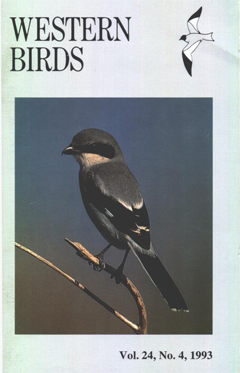
The breeding avifaunas of Figueroa Mountain and Big Pine Mountain in Santa Barbara County and Pine Mountain and Mount Pinos in Ventura and Kern counties are of great ornithological interest. These four mountains support islands of coniferous forest separated by other habitats at lower elevations. Little information on the birds of the first three has been published previously.
From 1981 to 1993, I, with the help of a number of observers, censused the summer resident birds of these four mountains, paying particular attention to the species restricted to high elevations. By comparing these avifaunas with each other, as well as with those of the San Gabriel, San Bernardino, and San Jacinto mountains, and the southern Sierra Nevada, I hope to add to current knowledge of the status and distribution of montane birds in southern California.
201-234
MICHAEL A. PATTEN
Robert Potvliege discovered a male Common Pochard (Aythya ferina) at Silver Lakes, San Bernardino County, California, on 11 February 1989. Silver Lakes, a small housing development with two man-made lakes and a golf course, is located adjacent to the town of Helendale, about 24 km north of Victorville. Following the report of the bird, the pochard was observed and photographed by others, including myself, through 17 February 1989.
As roughly one-third (22 of 69) of the Tufted Ducks (A. fuligula) recorded in California have returned for subsequent winters (Patten unpubl. data) and California’s only Smew (Mergellus albellus) returned for three successive winters (Roberson 1986), observers made an effort to relocate the Common Pochard in following years. Much searching during the winter of 1989/90 failed to reveal it, but there are similar lakes nearby along the Mojave River that could support the bird. It returned to Silver Lakes during the winter of 1990/91, when it was discovered by Eugene A. Cardiff on 18 January and remained until 23 February, during which time it was photographed and observed by many. The bird returned again in the winter of 1991/92, when it was first observed and photographed by Curtis A. Marantz on 14 January and was seen sporadically through 8 February. During the winter of 1992/93, I located the bird on 26 November, after which it was observed until 29 November, but apparently not thereafter.
The following description is based on my field notes, on those of various observers who submitted documentation to the California Bird Records Committee (CBRC), and on photographs of the bird.
235-240
M. RALPH BROWNING
Traill’s Flycatcher (sensu American Ornithologists’ Union [A.O.U.] 1957) is now recognized (A.O.U. 1973) as two species, Empidonax traillii (Audubon, 1828) (Willow Flycatcher) and E. alnorum Brewster, 1895 (Alder Flycatcher). The two species do not interbreed (Stein 1958, 1963, Gorski 1970), differ genetically (Zink and Johnson 1984, Seutin and Simon 1988), are usually though not always separated ecologically (Stein 1958, 1963, Barlow and McGillivray 1983, Zink and Fall 1981, Ewert 1981), and differ in song and calls (Stein 1958, LeGrand 1979, Lehman 1985).
Empidonax traillii vocalizes the “fitz-bew” song and breeds in swamps and willow thickets, usually along streams, in the conterminous United States and southern Canada. Empidonax alnorum vocalizes the “fee-bee-o” song and breeds in shrubs and alder thickets of the northeastern United States, Canada, and Alaska.
241-257
Robert McKernan
The eighteenth annual meeting of the Western Field Ornithologists was held jointly with the Arizona Field Ornithologists and Tucson Audubon Society from 30 July through 1 August 1993 at the Quality Inn in Tucson, Arizona. The Arizona folks organized a great meeting. Our field trips to all the southern Arizona haunts were exceptional. The Saturday paper session, banquet, and banquet speaker, Irene Pepperberg, were excellent. The local host committee—Joan and Bob Tweit, Shirley Davis, Tim Helentjaris, Barbara Koenig, Emery Froelich, Judy Edison, and Cherie Lazaroff—organized an outstanding meeting. I hope the WFO membership realizes how much time and effort are required to host one of our meetings—a special thanks to our Arizona members. During the planning, organizing, and operation of the Tucson meeting, one person deserves special credit, Joan Tweit, who gave so much of her time to oversee all activities, even the smallest detail, making the meeting very professional. In addition to the local committee, WFO appreciates the generosity of Wings, Inc., for its $200 contribution toward the meeting.
258-258
EDUARDO PALACIOS, ERIC MELLINK
Compared with the rest of Mexico’s, the avifauna of Baja California has been studied extensively (e.g., Grinnell 1928, Wilbur 1987). Nevertheless, within Baja California certain areas such as the Río Colorado delta have not been explored in detail. Knowledge of the bird life in this area is particularly important because of the striking changes in bird habitat along the Río Colorado and in its delta area (see Leopold 1970).
259-262
GUSTAVO D. DANEMANN, ROBERTO CARMONA
The coast of the southern Vizcaino Desert, Baja California Sur, includes three lagoons: La Bocana, El Coyote, and San Ignacio (Figure 1). The avifauna of La Bocana and San Ignacio lagoons was first described by Huey (1927). Since then, the only ornithological research in the area has been by Reitherman and Storrer (1981), Danemann (1991), and Danemann and Guzmán (1992), who studied various aspects of the avifauna of San Ignacio Lagoon. No ornithological information from La Bocana or El Coyote has been published since Huey’s early account.
In September 1991 we surveyed El Coyote and La Bocana lagoons, usually referred as “esteros.” Here we summarize observations recorded during those surveys.
263-266
MICHAEL C. LONG
In November 1989, Nancy Fraser, Eaton Canyon Nature Center staff, observed at her feeder in Altadena, Los Angeles County, California, a male Anna’s Hummingbird (Calypte anna) in an apparently weakened condition and with a dark “lump” on its bill. The bird was observed for more than a week, perching at the feeder for periods of up to several hours. On 19 November the hummingbird was increasingly lethargic and harassed by other hummingbirds when it attempted to feed. I suggested that Fraser attempt to capture the bird to provide aid and examine the bill. She was able to remove the bird from its perch by hand, but it expired within minutes. Examination of the lump on the bill revealed the intact head of yellowjacket wasp (Vespula pensylvanica), pierced from front to back directly between the compound eyes. The wasp head lay toward the distal end of the bill, approximately 4 mm from the tip (Figure 1).
267-269
Compiled by Mildred Comar
270-280