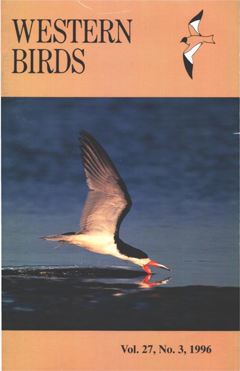
RICHARD A. ERICKSON
This report covers 180 records of 69 species submitted by 174 observers and evaluated by the California Bird Records Committee (hereafter the Committee or CBRC). Of these, 145 records were accepted, for an acceptance rate of 81%. Records from 1979 to 1994 are included, but the great majority are from 1993. Top honors among the counties go to San Diego with 15 accepted records, followed closely by San Francisco (14, all from SE Farallon I.), Santa Barbara (14), Monterey (13), Inyo (13), Orange (12), Los Angeles (12), and Marin (11).
One species, the Manx Shearwater (Puffinus puffinus), is added to the California state list, and one species, the Greater Shearwater (P. gravis), is removed following reconsideration of a previously accepted record. The list of native species thus stands at 582 (following AOU 1995); an additional eight nonnative species with well-established populations are also included on the California list maintained by the Committee. Other highlights from 1993 include two Red-tailed Tropicbirds (Phaethon rubricauda) in winter, one Gyrfalcon (Falco rusticolus), one Little Curlew (Numenius minutus), one Groove-billed Ani (Crotophaga sulcirostris), three Sulphur-bellied Flycatchers (Myiodynastes luteiventris), one Dusky Warbler (Phylloscopus fuscatus), one Rustic Bunting (Emberiza rustica), far northern records of the Broad-billed Hummingbird (Cynanthus latirostris) and Dusky-capped Flycatcher (Myiarchus tuberculifer), a wintering Blue-winged Warbler (Vermivora pinus), and record numbers of Zone-tailed Hawks (Buteo albonotatus; 11), and Philadelphia Vireos (Vireo philadelphicus; 10).
93-126
VALERIE L. LAYNE, ROBERT J. RICHMOND, PETER J. METROPULOS
Black Skimmers (Rynchops niger) have been observed on south San Francisco Bay during the nesting season since the late 1970s (Bailey et al. 1992, LeValley and Evens 1982, San Francisco Bay Bird Observatory unpubl. data, Winter and Manolis 1978, Yee et al. 1992), but nesting was never documented. They have nested in southern California since 1972, when five nests were discovered at the Salton Sea (McCaskie et al. 1974). The northernmost previously recorded nesting of the Black Skimmer in California was inland, at the Tulare Lake Basin in Kings County during the summer of 1986 (Erickson et al. 1986).
159-162
HORACIO DE LA CUEVA, GUILLERMO FERNÁNDEZ
The Black Skimmer (Rynchops niger) feeds strictly in shallow inshore waters, alone or in small groups (Erwin 1977a). Its diet is narrow; in Virginia, silversides (Menidia spp.) and killifishes (Fundulus spp.) make up 90% of its prey (Erwin 1977b). Both its feeding method and efficiency have been reported (Irby 1951, Tomkins 1951, Zusi 1959), but until recently little was known about its nocturnal feeding behavior (Gochfeld and Burger 1994).
Black Skimmers have recently colonized southern California (McCaskie et al. 1974, Palacios and Alfaro 1992) and the Gulf of California (Massey and Palacios 1994). They are now not rare along the Baja California peninsular coast (Palacios and Alfaro 1992, Carmona et al. 1995).
162-163
ADAM W. WHELCHEL, KATHY M. KEANE, MICHAEL N. JOSSELYN
Batiquitos Lagoon (33° 05' N, 117° 17' W) is a 241-hectare nontidal coastal wetland situated in northern San Diego County, California, within the city of Carlsbad, approximately 56 km north of San Diego and 145 km south of Los Angeles (Figure 1). The lagoon extends approximately 4 km inland from the Pacific Ocean and ranges in width from 0.2 to 0.4 km, with steep canyon slopes along the southern border and more gradual slopes to the north.
164-167
CHARLES T. COLLINS, KIMBALL L. GARRETT
Although many avian species in western North America have suffered recent population declines, a few have increased over the same period of time (Jehl and Johnson 1994). Many of the increases, such as parrots’ (Psittacidae), can be attributed strictly to anthropogenic influences (Johnston and Garrett 1994). Among those species showing apparent natural population increases in California is the Black Skimmer (Rynchops niger), which first occurred in the state in 1962 (Small 1963, 1994) and is now a resident breeder with a population in 1995 of about 1200 pairs. Recent studies in this region have documented its nocturnal activity pattern in the breeding season (Wilson 1995) and winter (Gazzaniga 1995, de la Cueva and Fernández 1996), food habits (Wilson 1995), and pattern of chick growth (Schew and Collins 1990, 1991). In this paper we review the status of the Black Skimmer in California with emphasis on the size and location of breeding colonies and overwintering aggregations (Figure 1). We also include a list of museum specimens of Black Skimmers taken in California (Appendix).
127-135
STORRS L. OLSON
Federico Craveri was a chemist, geologist, and naturalist who resided in Mexico for 18 years beginning in 1840. In 1847 he was joined for two years by his brother Ettore, who shared similar interests. Upon the death of their father, Ettore returned home to Italy to attend to the family museum in Brà, near Turin. Later, during his investigation of the economic potential of guano deposits on islands in the Gulf of California in 1856, Federico obtained specimens of a new species of murrelet, which, after considerable delay, was described and named by Tomasso Salvadori (1865) as Uria craveri (now Endomychura or Synthliboramphus craveri).
167-168
KATHLEEN T. GAZZANIGA
During the last two decades, Black Skimmers (Rynchops niger) have become increasingly common along the southern California coast. They are now found year-round in southwestern California (Collins et al. in press) and in northwestern Baja California (Palacios and Alfaro 1992). Little detailed information has been published, however, about their winter distribution and abundance in this region. Most previous studies of the Black Skimmer have focused on the breeding season, with little attention paid to survival, behavior, and habitat requirements in the wintering areas. Since the difficulties skimmers face on the breeding grounds (e.g., predation, human disturbance, parasitism, disease, inclement weather, contaminants, entanglements, and food shortage) may affect them also on the wintering grounds, Burger and Gochfeld (1990) suggested that further studies of wintering birds are needed. They suggested also that most mortality of adults takes place away from the breeding grounds and that young birds are particularly vulnerable during their first winter.
136-142
KATHY C. MOLINA
Black Skimmers (Rynchops niger) are widely distributed along the eastern and southern coasts of North America. Along the western coast their distribution is more restricted, ranging from Mexico north to southern California (American Ornithologists’ Union 1983, Collins and Garrett 1996); a few pairs have nested recently in coastal northern California (Yee et al. 1995, Layne et al. 1996). The ecology, reproductive biology, and behavior of Black Skimmer populations along the Atlantic coast and Gulf of Mexico have been the subject of numerous investigations (Erwin 1977, 1979, Loftin 1982, Custer and Mitchell 1987, Quinn 1989, 1990, Burger and Gochfeld 1990) and have been reviewed by Gochfeld and Burger (1994). The potential effects of environmental contaminants on these populations have also been described in several recent publications (Blus et al. 1980, White et al. 1984, King et al. 1986, King 1989, and Burger and Gochfeld 1992). Except by Schew and Collins (1990, 1991), little information has been published on the Pacific coast breeding populations. Black Skimmers nesting at the Salton Sea, a large interior saline basin in extreme southern California, have received only cursory attention since the establishment of breeding in 1972 (McCaskie et al. 1974, Grant and Hogg 1976, Grant 1978). This unique interior population is well established, having persisted for nearly 25 years. In this paper I describe the nesting habitat, population trends, phenology, clutch size, and hatching success of Black Skimmers nesting at the Salton Sea during the 1990s.
143-158