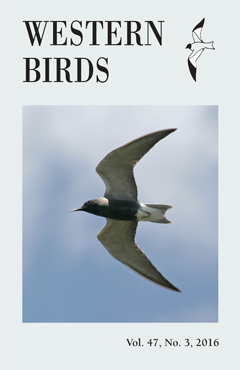
W. DAVID SHUFORD, KRISTIN A. SESSER, KHARA M. STRUM, DAVID B. HAINES, DANIEL A. SKALOS
Broad-scale surveys or monitoring of the distribution and abundance of waterbirds in the interior of the American West have been limited despite great losses of waterbirds’ historic foraging and nesting habitats. Yet such work is crucial for assessing conservation status, population trends, habitat health, and the effects of management and environmental change on waterbirds. As part of the Western Colonial Waterbird Survey—an inventory of 19 species across 11 western states—we focused on three species of terns with conservation concern and assessed their distribution and numbers throughout their inland breeding ranges in California from 2009 to 2012. We compare these numbers to data from comparable surveys from 1997 to 1999. Climatic conditions strongly influenced the distribution and abundance of all three species, especially precipitation, which was below the long-term mean in relevant regions of the state for 3–4 years preceding the second round of surveys, greatly reducing foraging and nesting habitat. For the Black Tern (Chlidonias niger) and Forster’s Tern (Sterna forsteri), respectively, statewide inland totals in 2009–2012 were about 49% and 26% of those in 1997–1999. Similarly, the numbers of breeding sites for those species were greatly reduced, particularly in northeastern California and the San Joaquin Valley. Patterns were less clear and varied regionally for the Caspian Tern (Hydroprogne caspia), as totals were greatly affected in all years by generally high, but variable, numbers at the Salton Sea. In northeastern California, however, drought reduced numbers of breeding Caspian Terns at least 10-fold from 1999 to 2009, and that region’s contribution to the statewide inland total dropped from 68% in 1999 to 1% in 2009. It is unclear if these patterns for the three tern species will prove to be part of a longer-term declining trend or just a tribulation the terns faced from short-term fluctuations in precipitation. The latter may be likely given California’s pattern of drought recurring about every 15 years through the 20th century. However, the relatively benign climatic patterns during this century may not persist in the future, and any drought effects come on top of the loss of >90% of California’s historic wetlands and a severe over-allocation of the state’s water resources. Designs for long-term monitoring of inland tern populations should consider the state’s highly variable annual precipitation and the possibility of some species shifting among coastal and inland breeding sites. Management in the face of such variability and the uncertainty of future climate may be difficult, but securing adequate water in both dry and wet periods will be important as competition for supplies increases.
182-213
DAVID L. SWANSON, MARK D. DIXON, JEFFREY S. PALMER
VIRGINIA’S WARBLER (OREOTHLYPIS VIRGINIAE) REACHES THE NORTHEASTERN LIMIT OF ITS BREEDING RANGE IN THE SOUTHERN BLACK HILLS OF SOUTH DAKOTA, WHERE IT IS CONSIDERED A SPECIES OF CONSERVATION CONCERN. THIS POPULATION OCCURS IN PINE–JUNIPER–SHRUB HABITAT IN SEVERAL CANYONS IN EXTREME WESTERN CUSTER COUNTY. ADDITIONAL SUCH HABITAT OCCURS IN THE SOUTHERN BLACK HILLS SOUTH AND EAST OF THE DOCUMENTED BREEDING POPULATIONS, BUT THESE AREAS HAVE RECEIVED FEW SYSTEMATIC SURVEYS, AND WHETHER VIRGINIA’S WARBLER OCCUPIES THEM WAS UNCERTAIN. THEREFORE, TO DEFINE THE SPECIES’ DISTRIBUTION IN THE SOUTH DAKOTA BLACK HILLS MORE PRECISELY, WE SURVEYED WITH THE AID OF BROADCAST SONG AND REVIEWED OTHER REPORTS. VIRGINIA’S WARBLERS OCCURRED IN APPROPRIATE HABITATS ALL ALONG THE SOUTHWESTERN FRONT (APPROXIMATELY 30 KM TOTAL) OF THE BLACK HILLS IN CUSTER COUNTY BUT DID NOT OCCUR IN SIMILAR HABITAT ALONG THE SOUTHEASTERN FRONT, APPROXIMATELY 25 KM DISTANT. THE SPECIES’ RELATIVE ABUNDANCE IN PREVIOUSLY AND NEWLY IDENTIFIED PINE–JUNIPER–SHRUB HABITATS WAS SIMILAR. VIRGINIA’S WARBLER OCCURRENCE WAS POSITIVELY ASSOCIATED WITH SHRUB COVER (PRIMARILY MOUNTAIN-MAHOGANY, CERCOCARPUS MONTANUS), PINE OVERSTORY, AND SLOPES OF >15°. ITS ASSOCIATION WITH THE SPOTTED TOWHEE (PIPILO MACULATUS) WAS NEGATIVE, WITH THE YELLOW-RUMPED WARBLER (SETPHAGA CORONATA) TENDED TOWARD POSITIVE, AND WITH THE DUSKY FLYCATCHER (EMPIDONAX OBERHOLSEI) WAS VARIABLE (NEGATIVE ALONG THE SOUTHWESTERN FRONT BUT WEAKLY POSITIVE ACROSS ALL SITES). THESE DATA EXTEND THE DOCUMENTED BREEDING RANGE OF VIRGINIA’S WARBLER IN SOUTH DAKOTA BY MORE THAN 20 KM TO THE SOUTHEAST. TO CLARIFY CONSERVATION PRIORITIES FOR THIS SPECIES AT THE NORTHEASTERN LIMIT OF ITS RANGE, FUTURE STUDIES SHOULD DELINEATE LOCAL AND LANDSCAPE-LEVEL CHARACTERISTICS OF THIS POPULATION’S HABITAT MORE PRECISELY AND ADDRESS ITS SOURCE–SINK POPULATION DYNAMICS.
214-226
DOUGLAS VAUGHAN
THE NORTHERN SAW-WHET OWL (AEGOLIUS ACADICUS) NESTS WIDELY IN NORTH AMERICA AND IS REGULARLY REPORTED DURING THE BREEDING SEASON (ROUGHLY FEBRUARY–MAY) IN ALAMEDA AND CONTRA COSTA COUNTIES IN THE SAN FRANCISCO BAY AREA. DOCUMENTED INSTANCES OF BREEDING ARE SCARCE, HOWEVER: BREEDING BIRD ATLASES FOR THESE COUNTIES REPORT BREEDING OF NORTHERN SAW-WHET OWLS ON ONLY A FEW OCCASIONS, ALL IN THE OAKLAND–BERKELEY HILLS (GLOVER 2009, RICHMOND ET AL. 2011). NONETHELESS, FROM 2004 TO 2015, SEVERAL COLLEAGUES AND I OBSERVED 19 NORTHERN SAW-WHET OWLS NESTING IN TREE-MOUNTED BOXES DESIGNED FOR WOOD DUCKS (AIX SPONSA) ON PROPERTY MANAGED BY THE EAST BAY MUNICIPAL UTILITY DISTRICT (EBMUD) IN CONTRA COSTA COUNTY. THE BOXES ARE DISTRIBUTED OVER A DISTANCE OF ABOUT 1500 M ALONG SAN PABLO CREEK AND THE ADJACENT SHORELINES OF SAN PABLO RESERVOIR, IN A RIPARIAN WOODLAND OF MONTEREY PINE (PINUS RADIATA), COAST LIVE OAK (QUERCUS AGRIFOLIA), CALIFORNIA BAY LAUREL (UMBELLULARIA CALIFORNICA), AND ARROYO WILLOW (SALIX LASIOLEPIS), AT ELEVATIONS OF ABOUT 100 M. THE STUDY SITE IS PART OF AN EXTENSIVE AREA OF MANAGED WATERSHEDS AND REGIONAL PARKS IMMEDIATELY EAST OF THE URBAN CORRIDOR ON THE EAST SHORE OF SAN FRANCISCO BAY.
227-230
LANCE MORROW, JILL MORROW
NORTHERN HARRIERS (CIRCUS CYANEUS) USUALLY NEST NEAR WATER OR WETLANDS IN OPEN, TREELESS HABITATS WITH DENSE VEGETATION. HERE WE DESCRIBE TWO NORTHERN HARRIER NESTS ~800 M APART IN ANOTHER SITUATION, SAGEBRUSH STEPPE ON A MOUNTAIN SLOPE IN CENTRAL WYOMING. ON 28 MAY 2002, WE OBSERVED A MALE AND A FEMALE HARRIER ON THE SOUTH SLOPE OF CROOKS MOUNTAIN, ~16 KM SOUTH-SOUTHWEST OF JEFFREY CITY, FREMONT COUNTY, WYOMING. ON A SUBSEQUENT VISIT, ON 20 JULY 2002, WE LOCATED THEIR NEST (NEST 1, 42.3676° N, 107.9186° W, ELEVATION 2374 M) AFTER A BRIEF SEARCH OF THE AREA WHERE A FEMALE HARRIER FLUSHED FROM THE SAGE AS WE DROVE A LIGHTLY TRAVELED GRAVEL ROAD. ON 8 AUGUST 2002 WE LOCATED THE SECOND HARRIER NEST (NEST 2, 42.3632° N, 107.9110° W, ELEVATION 2299 M) IN A SIMILAR MANNER. BOTH NESTS WERE WITHIN 10 M OF THE CENTERLINE OF THE ROAD. THE FEMALES VOCALIZED AND CIRCLED WITHIN 100 M OF EACH NEST WHILE WE INVESTIGATED. THESE WERE THE ONLY HARRIERS WE HAVE OBSERVED DURING THE BREEDING SEASON IN SAGEBRUSH STEPPE DURING 5 YEARS OF FIELD RESEARCH IN CENTRAL WYOMING. EACH NEST WAS CONSTRUCTED ON THE GROUND OF DEAD SAGEBRUSH LIMBS, LINED WITH GRASS, AND PARTIALLY COVERED BY BIG SAGEBRUSH (ARTEMISIA TRIDENTATA) BUSHES APPROXIMATELY 80 CM TALL.
231-233
CHANG-YONG CHOI, XIANGMING XIAO
Many birds collide with static and mobile man-made structures whether concealed or conspicuous, raising conservation concerns (Bevanger 1994, Drewitt and Langston 2008, Martin 2011). In certain species, even predatory raptors, such high susceptibility to collision may be caused by relatively poor frontal vision (Bevanger 1994, Martin 2011), but it is still unclear why birds collide with obstacles under conditions of both good and poor visibility (Drewitt and Langston 2008, Martin 2011). Birds of prey are also known to be vulnerable to collision with man-made structures such as wind turbines (Madders and Whitfield 2006, Harness 2007, Lovich 2015), power lines and communication towers (Harness 2007, Jenkins et al. 2010), fast-moving vehicles and aircraft (Harness 2007), barbed wire or wire fence (Edeburn 1973, Anderson 1977, Harness 2007), as well as windows (Boal and Mannan 1999). All these collisions with man-made structures are just a few examples of humanity’s numerous and diverse indirect effects on raptor populations. Here we report an unusual observation of mortality of a young raptor caused by an apparent collision with an artificial nesting structure established for ducks.
234-236
CARL RUDEEN, FRED BASSETT
Before the 1960s, Anna’s Hummingbird (Calypte anna) nested only in California and northwestern Baja California (Clark and Russell 2012). Today, the species has expanded its breeding range dramatically north into Oregon, Washington, and Vancouver Island, British Columbia, as well as eastward into southern Arizona, with one instance of breeding recorded in west Texas (Williams 1976). Clark and Russell (2012) attributed the range expansion over the last 80 years to adaptation to human habitation, specifically to gardens and the “widespread use of feeders.” The breeding range now appears to be expanding eastward into Idaho, as evidenced by Bassett’s documentation of gravid Anna’s Hummingbirds there.
237-241
PETER PYLE, MARTIN REID
Jaegers molt at sea, and these poorly known molts result in variable and confusing fall and winter plumages. We summarize the progression of molts and appearance of the plumages in 11 Long-tailed Jaegers (Stercorarius longicaudus), of four age groups, photographed off Chile in December 1993. The central rectrices in these birds were short, blunt-tipped, and either plain brown or boldly barred black and white, indicating that, in at least some individuals, these feathers were replaced for a second time within the molt cycle. The body plumage of five adults was quite different from the breeding plumage and differed from nonbreeding plumages depicted in the literature. Individuals replacing primaries during the second prebasic molt showed worn and bleached head and body feathers, indicating only limited feather replacement since the preformative molt rather than a complete body molt in their second fall as widely reported. Examination of 647 specimens confirmed that in jaegers body-feather molt is partial to incomplete in fall and usually complete in spring. Using the Humphrey–Parkes nomenclature, we thus propose a novel molt and plumage terminology for jaegers, in which birds breed in basic plumage and undergo a partial prealternate body molt in fall. Under this interpretation, a limited first prealternate body-feather molt occurs during the second summer and fall, and the first cycle is completed at an age of 15–18 months. The later and complete preformative molt, from November to March, produces stronger formative feathers, allowing the second prebasic body molt to be “pushed back” by 6 months, leading to a spring-to-spring cycle of prebasic molt. We suggest that a prealternate body-feather molt has evolved in jaegers to provide protective coloration for flight-feather molt, as has been proposed for ducks and ptarmigan, or perhaps for social signaling or just to replace feathers that wear quickly because of intense annual solar exposure.
242-257