STEPHEN C. ROTTENBORN, JOSEPH MORLAN
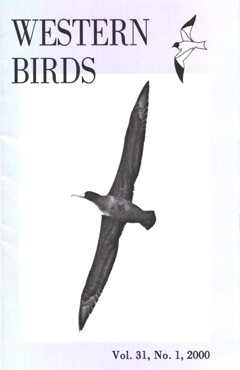
The California Bird Records Committee assessed 241 records of 98 species in the past year, accepting 173 of them. New to California were the Great-winged Petrel (Pterodroma macroptera), photographed and videotaped at Cordell Bank off Marin County; the Band-tailed Gull (Larus belcheri), photographed at the Tijuana River mouth, San Diego County; and Couch’s Kingbird (Tyrannus couchii), photographed and audiotaped at Fullerton, Orange County. With the recognition of the Long-billed Murrelet (Brachyramphus perdix) and Blue-headed Vireo (Vireo solitarius) as species, plus more recent additions, California’s bird list now stands at 613 species.
1-37
STEVE N. G. HOWELL, CHRIS CORBEN
38-49
STEVE N. G. HOWELL, CHRIS CORBEN
The Humphrey-Parkes system of molt nomenclature takes as the starting point of cyclic plumage succession the highly variable molt that replaces juvenal plumage, entailing inconsistency. If all "postjuvenal" molts are called prebasic, homology between so-called first basic and second basic plumages of birds the same age is lost. We suggest that the juvenal plumage be considered synonymous with first basic plumage, and we define the first basic plumage cycle as the period between the acquisition of juvenal (= first basic) plumage and the acquisition of the second basic plumage. Consequently, the traditional first basic plumage of birds with a single molt and plumage per cycle (e.g., Procellariiformes) should be renamed the second basic plumage. That of species with more complex molt strategies should be considered as a variable, inserted plumage not homologous with a basic plumage. In this way, consistent nomenclature for all prebasic molts and basic plumages of all species can be achieved, regardless of whether additional plumages have been inserted into the basic cycle. We define four strategies that incorporate most, if not all, known molt strategies and show how these build on the primitive basic strategy, taking juvenal (= first basic) plumage as a homologous starting point.
50-56
PAUL LEHMAN
For many years I have had an interest in the autumn migration in western Alaska's islands. In addition to a single fall visit to Attu Island, in the western Aleutians, in 1993, I have been able to visit Gambell, Saint Lawrence Island, in early fall 1992 (six days in late August), 1997 (seven days in late August), 1998 (16 days, through early September), and 1999 (45 days, 20 August to 3 October). Fay and Cade (1959) and Sealy et al. (1971) made detailed censuses on Saint Lawrence Island, primarily in summer during the 1950s and 1960s. Birders have visited Gambell regularly during the late spring (late May and early June) since the mid-1970s.
57-60
JAMES W. CORNETT
The Greater Roadrunner (Geococcyx californianus) feeds on a remarkable diversity of animals including rodents, birds, reptiles, and arthropods (Hughes 1996). Often the species demonstrates surprising adaptability in acquiring prey: individual roadrunners have been observed capturing insects by turning over surface objects (Jaeger 1947), hiding near artificial feeders to take hummingbirds (Spofford 1975), and removing passerines from mist nets (Barclay 1977).
61-62
Bruce WEBB
A fact-filled tome at 600 pages, the Colorado Breeding Bird Atlas is a must-have for anyone interested in atlasing and is required reading for anyone interested in the breeding distribution and biology of the 265 species of birds that breed in Colorado.
63-64
Steve N. G. Howell
This set of recordings covers an impressive variety of vocalizations from 259 bird species characteristic of the Rocky Mountain states and provinces — from the Horned Grebe to Hepatic Tanager, Mountain Plover to McCown's Longspur.
64
ROBERT A. HAMILTON, N. JOHN SCHMITT
The Merlin (Falco columbarius) is a small circumboreal falcon with nine currently recognized subspecies, three of which occur in North America: the pale Prairie Merlin (F. c. richardsonii) of the northern Great Plains, the Black Merlin (F. c. suckleyi) of the Pacific Northwest, and the widespread and medium-hued Taiga Merlin (F. c. columbarius), the paler western component of which was once considered a fourth subspecies, F. c. bendirei (American Ornithologists’ Union [AOU] 1957).
65-68