EDWARD R. PANDOLFINO, NATHAN D. PIEPLOW
There are distinct regional differences among the vocalizations of the White-breasted Nuthatch (Sitta carolinensis), but only one subspecies (S. c. carolinensis) has been the subject of published vocal analyses. We used recordings made throughout the ranges of four U.S. subspecies to compare their vocalizations qualitatively and quantitatively, finding that these vocalizations may be categorized in three groups, eastern (S. c. carolinensis), interior west (S. c. nelsoni and S. c. tenuissima), and Pacific (S. c. aculeata). All four subspecies sing a simple song consisting of an evenly spaced series of overslurred notes. The rate of this song varies from <5 notes/sec to >12 notes/sec. The pitch of these songs increases from east to west, being lowest in S. c. carolinensis and highest in S. c. aculeata. Sitta c. aculeata also has an additional song unique to that taxon consisting of a series of sharply slurred, evenly spaced notes that fall, then rise, and then fall in pitch. Both S. c. carolinensis and S. c. aculeata frequently give a simple call note that is very distinctly and rapidly modulated; it is significantly higher in pitch in S. c. aculeata than in S. c. carolinensis. Neither interior subspecies makes a similar call. Both interior subspecies commonly give two calls absent from the repertoires of S. c. carolinensis and S. c. aculeata, one consisting of tightly paired notes given at a constant pace, the other a very rapid, unevenly spaced series of single notes given in short bursts. We found no diagnostic differences between the two interior subspecies in either song or calls.
278-290
BRANDI RINGGENBERG, KEVIN WINKER
Successfully rearing two broods in one season (double brooding) is rare at high latitudes, and few well-documented cases exist in the Arctic. There are numerous suggestions in the literature that the Common Redpoll (Acanthis flammea) is occasionally a double-brooded species. We examined banding data sets from interior Alaska, specimens in the University of Alaska Museum bird collection, and Alaska nest-record cards to understand the timing of reproduction in Alaska boreal forest and tundra. In interior Alaska Common Redpolls exhibit characteristics of breeding for over four months, plenty of time to successfully raise two broods. Furthermore, tundra breeding takes place after most boreal forest breeding, making it possible that individuals could rear two broods in different regions, as has been suggested in northern Europe. Finally, pronounced annual variation in production of young in Fairbanks was not correlated with production of tree seeds in the previous summer.
291-298
RYAN J. MERRILL, MATT BARTELS
Since its eighth report (Aanerud 2011) the Washington Bird Records Committee (WBRC) has reviewed 291 reports representing 92 species and seven other subspecies and forms, accepting 232 of them, an acceptance rate of 80%. Most of these birds were observed between 2008 and 2010. Six new species and one subspecies group are added to the Washington state checklist: Providence Petrel (Pterodroma solandri), Hawaiian Petrel (P. sandwichensis), Greater Pewee (Contopus pertinax), Yellow-bellied Flycatcher (Empidonax flaviventris), Variegated Flycatcher (Empidonomus varius), Bell’s Vireo (Vireo bellii), and Interior or Lead-colored Bushtit (Psaltriparus minimus plumbeus). In addition, the WBRC removed two species, the Mute Swan (Cygnus olor) and American Black Duck (Anas rubripes), from the state checklist. The Washington state list now stands at 498 species.
299-325
HAROLD F. GREENEY, CHRIS E. HAMILTON, EVELYNG K. ASTUDILLO-SÁNCHEZ, SUSAN M. WETHINGTON, ERIC R. HOUGH, CHRISTINA M. RIPPLINGER, KRISTA K. SCHMIDT
THE SELECTION OF SAFE BREEDING SITES IS AN IMPORTANT BEHAVIORAL COMPONENT OF AVIAN POPULATION ECOLOGY (NEWTON 1998), AND NEST PREDATION IS A MAJOR ECOLOGICAL FORCE LIMITING REPRODUCTIVE SUCCESS AND SHAPING THE SPATIAL DISTRIBUTIONS OF BREEDING BIRDS (RICKLEFS 1969, MARTIN 1995). AVIAN NESTING SITES CAN BE EXAMINED AT MULTIPLE SPATIAL SCALES, FROM BROAD LANDSCAPE LEVELS, TO NEST AND PATCH CHARACTERISTICS, TO MICROSITE FEATURES SUCH AS OVERHEAD CONCEALMENT AND NEST ORIENTATION (MARTIN 1993, PATON 1994). MICROHABITAT FEATURES OF THE VEGETATION USED AS NEST SUBSTRATES ARE ESPECIALLY IMPORTANT FOR CAMOUFLAGE AND PROTECTION FROM INCLEMENT WEATHER (MARTIN 1995, DEEMING 2002, KOLBE AND JANZEN 2002). NUMEROUS STUDIES HAVE LINKED SPECIFIC ASPECTS OF NEST MICROSITES AND NESTING SUCCESS IN A VARIETY OF BIRDS (E.G., MARTIN AND ROPER 1988, LIEBEZEIT AND GEORGE 2002, AGUILAR ET AL. 2008, POWELL ET AL. 2010, MILLER 2014). WHILE MANY STUDIES OF AVIAN NESTING SUCCESS FOCUS ON PREDATION OR BROOD PARASITISM (E.G., LI AND MARTIN 1991, LARISON ET AL. 1998, LIMA 2009), IN SOME SPECIES, PARTICULARLY SPECIES WITH NARROW PHYSIOLOGICAL TOLERANCES LIKE HUMMINGBIRDS (CALDER AND BOOSER 1973, CALDER 1994, 2002), NEST PLACEMENT MAY ALSO BE IMPORTANT FOR MAINTAINING THE MICROCLIMATE AROUND THE NEST (DEEMING 2002).
326-330
STEVEN G. MLODINOW, TONY LEUKERING
Colorado’s first accepted record of a Cave Swallow (Petrochelidon fulva) involved an immature photographed at Prewitt Reservoir, Washington County, on 17 July 2013. The bird occurred amid this species’ substantial range expansion and a complex, rapidly changing pattern of vagrancy in the United States and Canada over the last 50 years. Here we detail the species’ colonization of the U.S. and summarize these patterns of vagrancy.
331-335
LARRY SIEMENS
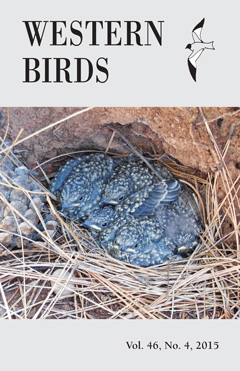
I observed Townsend’s Solitaire (Myadestes townsendi) nestlings fed by both their parents and an American Robin (Turdus migratorius) on the same day. On 2 and 3 July 2015 at Leoni Meadows, south of Grizzly Flat, southeast of Placerville, El Dorado Co., California, at about 1250 m elevation, I observed a solitaire nest with five nestlings that appeared to be within a week of fledging. Shaded by tall Ponderosa Pines (Pinus ponderosa), the nest was on the ground, surrounded by pine needles, in a south-facing dirt bank below a parking lot near the busy center of a Christian youth camp (Figure 1; see also this issue’s front cover).
336-338
ISRAEL MORENO-CONTRERAS, ANA GATICA-COLIMA, DIANA VENEGAS
The Montezuma Quail (Cyrtonyx montezumae) occurs widely from central Arizona, southern New Mexico, and western Texas to southern Mexico, inhabiting pine–oak forests, arid montane scrub, and temperate grasslands (AOU 1998). In Mexico, the species occurs as an uncommon to fairly common year-round resident in the interior from Sonora and Coahuila south across the highlands to Oaxaca (Howell and Webb 1995). It is uncommon to fairly common (in suitable habitat) at several localities in and near the Sierra Madre Occidental of western Chihuahua, including minor ranges to the east (Howell and Webb 1995, Navarro and Peterson 2007, BirdLife International and NatureServe 2014; Figure 1), but it may now be rare or extirpated locally in much of its historic range.
339-342
STEPHEN M. FETTIG, CHARLES D. HATHCOCK
Examination of wing-feather molt often provides information essential for aging birds in the hand (Mulvihill 1993, Pyle 1997b, 2008). Correctly aging birds is important for understanding the causal relationships between age-class survival rates and population changes (DeSante et al. 2005). For example, correctly aging birds facilitates understanding of climate effects on reproduction better than merely monitoring population numbers because reproduction varies widely with annual weather patterns (DeSante and O’Grady 2000). Age-class information can also provide a clear measure of habitat quality without confounding effects such as population sources and sinks (Van Horne 1983) or misleading habitat-quality information based on relative abundance or population size (Pulliam 1988). Changes in bird populations often lag changes in the survival rate of an age class, while environmental changes often affect one age class immediately or after a short lag (Temple and Wiens 1989).
343-346
Jeffrey S. Marks
With the possible exception of hummingbirds, no avian group is more popular than owls. Perhaps for this reason, the number of owl books that have appeared in recent decades is mind boggling. Some are quite good; far too many are unexceptional. The best have been produced by owl specialists who are excellent researchers but not necessarily great writers. Thus I had high expectations when I learned that Scott Weidensaul had written a new owl book. Not only is he an experienced owl researcher, he’s a talented nonfiction writer. His nearly 30 books include The Ghost with Trembling Wings: Science, Wishful Thinking and the Search for Lost Species (2002, North Point Press), Of a Feather: A Brief History of American Birding (2007, Harcourt), and Living on the Wind: Across the Hemisphere with Migratory Birds (1999, North Point Press). The last was a finalist for the Pulitzer Prize and is my favorite among his titles.
347-348
Justyn Stahl
Seawatching, as authors Ken Behrens and Cameron Cox define it, is the “challenging act of identifying waterbirds in flight.” The birds are in motion. They are frequently distant and typical field marks may not be useful. More often than not there are no landmarks to orient the observer. And the best conditions for seawatching are often harrowing, when storms blow flocks and normally pelagic species close to shore. But seawatching can also be mind-blowing. Imagine 2000 Sabine’s Gulls flying through your field of view, or over 1,000,000 Short-tailed Shearwaters streaming past, or the moment a Great-winged Petrel chances by a tourist-choked promontory in southern California. If you do not have the physical or financial strength to regularly join pelagic excursions, your best bet for encountering ocean-going species is from shore with a spotting scope. Digesting even a small portion of the wealth of information provided in the Peterson Reference Guide to Seawatching will doubtlessly enhance your time searching the water, from land or boat.
348-350
PHILIP UNITT
Peer review is a critical step in the publication of a scientific journal. I thank the following people for their generosity in taking the time to provide this essential service sustaining the scientific quality of Western Birds for volume 46
350
RYAN P. O’DONNELL
Hybridization between the Dusky Grouse (Dendragapus obscurus) and Sharp-tailed Grouse (Tympanuchus phasianellus) has been rarely documented. The only published record from the wild is of one collected at Osoyoos, British Columbia, in 1906 (Brooks 1907, Lincoln 1950). There is one record of this hybridization between captive birds (McCarthy 2006).
351-352