DALE W. STAHLECKER, EDWARD P. MACKERROW, HIRA A. WALKER, JONATHAN P. BATKIN, BERNARD R. FOY
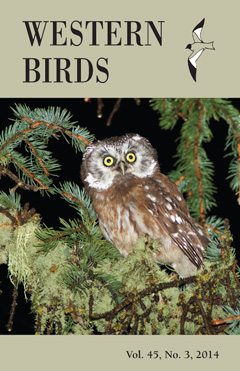
To better understand the status of the Boreal Owl (Aegolius funereus) at the southern extremity of its North American range, we conducted audio playback surveys between late July and mid-October 2012 at seven of the nine northern New Mexico locations where the species had been documented between 1987 and 1993, as well as four additional locations 10–15 km from sites of previous detections. All survey locations were in subalpine conifer forest at elevations >3000 m above sea level. In total, we called in at least 12 individuals (6 adults and 6 juveniles) at or near six of the seven historical locations and at least three adults at two new locations. Of the eight locations with confirmed Boreal Owl detections, two were in the San Juan Mountains, two were in the Jemez Mountains, and four were in the Sangre de Cristo Mountains. Recently fledged owls were seen at both San Juan Mountain sites and photo-documented at one site. Adult owls were photo-documented at the other six locations. Detection of Boreal Owls at six of seven historical locations confirmed the species’ long-term residency in New Mexico’s three northern mountain ranges. While Boreal Owls have likely been present in New Mexico since the Pleistocene, climate change appears likely to threaten their high-elevation habitat, particularly since more frequent and larger fires are predicted in the future as the forest dries.
166-175
RYAN A. PHILLIPS, WILLIAM G. BOUSMAN, MIKE ROGERS, RYAN BOURBOUR, BREANNA MARTINICO, MICHAEL MAMMOSER
We documented successful nesting of a pair of Swainson’s Hawks (Buteo swainsoni) over two consecutive years (2013 and 2014) in Coyote Valley, California, which represents the species’ first nesting in Santa Clara County since 1894 and a range expansion of approximately 60 km from the Central Valley into the species’ historic range. It confirms that there is habitat in Santa Clara County for breeding Swainson’s Hawks, which has implications for conservation. Expansion of this species’ breeding, in recent years, has been documented in other counties within the central and northern Coast Ranges of California, including San Benito, Napa, and Sonoma, suggesting that efforts toward Swainson’s Hawk conservation in California have allowed this species to recolonize some of its historical breeding range, or that Swainson’s Hawk may be adapting to new areas of natural or human-modified habitats.
176-182
ELLEN S. MARTINSEN, JOSEPH J. SCHALL
We photographed nests of Pelagic Cormorants (Phalacrocorax pelagicus) on cliff ledges at two colonies in Mendocino and Sonoma counties, California, from 1986 to 1996. In 135 comparisons of the positions of nests in different years, we found that 92% of the nests shifted by <25 cm (approximate diameter of a Pelagic Cormorant nest), and in 24% of comparisons the shift was <5 cm. Some nests were placed within a few centimeters of previous sites for as long as nine years. The rate of reuse of nest sites was high on both small ledges and on large shelves where the nest could have readily been shifted. At sites where substantial rock substrate sloughed off the cliff face in the previous year, nests were placed precisely at former sites. This high rate of nest reuse is striking because many apparently suitable sites on these cliffs remain unused.
183-189
ANTHONY J. BRAKE, HARVEY A. WILSON, ROBIN LEONG, ALLEN M. FISH
Historical records from the early 1900s, as well as surveys updated in the late 1980s and more recent information from local breeding bird atlases, indicate that Ospreys rarely nested on San Francisco Bay prior to 2005. In 2013, we surveyed nesting Ospreys baywide and located 26 nesting pairs, 17 of which were successful and fledged 44 young. We also report on findings from previous annual nest surveys of a portion of San Francisco Bay beginning in 1999. These results demonstrate a greater breeding abundance than has previously been recognized. The density of Osprey nests is highest near the north end of San Francisco Bay, but nesting also appears to be expanding southward. Nearly all of the nests observed were built on artificial structures, some of which were inappropriate and required nests to be removed. Over half of unsuccessful pairs experienced significant human disturbance. We recommend that conservation efforts focus on reducing this ratio, and to help do so, we urge erecting nest platforms as part of efforts to deter nesting when it conflicts with human activity.
190-198
WILLIAM H. HOWE, SARTOR O. WILLIAMS III
The California Gull (Larus californicus) has been expanding its breeding range southward in the western United States, including in the Rocky Mountains, for several decades. In New Mexico, the species was accidental in occurrence until numbers appeared in summer in the mid-1970s. Here we document the first breeding of the California Gull in New Mexico, where a small colony containing four broods was discovered in 2013; this event extends the known breeding range southward in the Rocky Mountains by about 150 km. Nesting will likely continue at least intermittently in New Mexico as water levels in the state’s reservoirs, and the presence of islands suitable for nesting, fluctuate over time.
199-203
CHAD T. HANSON
Numerous avian species are positively associated with “snag forest” habitat created by patches of high-severity fire, mainly because of the abundance of standing fire-killed trees (snags) and fire-following shrubs. There is now considerably less severe fire than there was historically in the forests of California’s Sierra Nevada, owing to fire suppression. Moreover, under current policies for management of public and private forest, much of the snag forest created by fire is subjected to post-fire logging of snags. Mechanical mastication and herbicide spraying of shrubs, followed by planting of conifers, are also common, and large-scale programs of mechanical thinning seek to prevent creation of this habitat. Thus there is reason for concern for birds associated with snag forest. I synthesized existing research to identify the species positively associated with this habitat and assessed their population trends according to the Breeding Bird Survey. In the Sierra Nevada 24 species are associated with snag forest, and half of these are declining or are too rare for the Breeding Bird Survey to detect any trend. For snag-forest species, there are significantly more declines than increases (all snag-forest species with statistically significant population trends are declining), whereas species of unburned forest manifest no such pattern. These results indicate a need for more managed wildland fire, and for current management policies, both pre- and post-fire, to be revisited, particularly in national forests where most of the post-fire habitat exists.
204-212
WALTER SZELIGA, LANCE BENNER, JOHN GARRETT, KATHI ELLSWORTH
The Red Crossbill (Loxia curvirostra) is notable for its extensive morphological and vocal variation, which may represent a complex of incipient and cryptic species differing by flight call. To date, at least 10 distinct flight-call groups have been identified in North America. To our knowledge, however, the flight calls of the Red Crossbills of southern California have not been studied. To begin to address this deficit, we recorded Red Crossbill flight calls at 17 locations in and near the Transverse and northern Peninsular ranges from January 2011 through April 2014. These crossbills were associated with multiple species of conifers, including Jeffrey Pine, Sugar Pine, White Fir, and ornamental plantings of non-native Aleppo Pine, at elevations from 380 to 2700 m. Analysis of sonograms of these flight calls reveals primarily type 2 of Groth’s (1993) classification system but also migrants of type 3 in the Mojave Desert.
213-223
MICHELLE L. FEARON, PETER S. COATES
Nest parasitism occurs when a female bird lays eggs in the nest of another and the host incubates the eggs and may provide some form of parental care for the offspring (Lyon and Eadie 1991). Precocial birds (e.g., Galliformes and Anseriformes) are typically facultative nest parasites of both their own and other species (Lyon and Eadie 1991). This behavior increases a female’s reproductive success when she parasitizes other nests while simultaneously raising her own offspring. Both interspecific and conspecific nest parasitism have been well documented in several families of the order Galliformes, particularly the Phasianidae (Lyon and Eadie 1991, Geffen and Yom-Tov 2001, Krakauer and Kimball 2009). The Chukar (Alectoris chukar) has been widely introduced as a game bird to western North America from Eurasia and is now well established within the Great Basin from northeastern California east to Utah and north to Idaho and Oregon (Christensen 1996). Over much of this range the Chukar occurs with other phasianids, including the native Greater Sage-Grouse (Centrocercus urophasianus), within sagebrush (Artemisia spp.) steppe (Christensen 1996, Schroeder et al. 1999, Connelly et al. 2000). Chukar typically exploit a broader range of habitats than do sage-grouse, but both species use the same species of sagebrush and other shrubs for nesting cover (Christensen 1996, Schroeder et al. 1999). Chukar are known to parasitize nests of other individuals of their own species (Geffen and Yom-Tov 2001), but we are unaware of reported evidence that Chukar may parasitize nests of sage-grouse. Here we describe a case of a Chukar parasitizing a sage-grouse nest in the sagebrush steppe of western Nevada.
224-227
WILLIAM E. HAAS
In San Diego County, California, anecdotal records of free-ranging Black-throated Magpie-Jays (Calocitta colliei) date back to the 1970s in the vicinity of the Solana Beach neighborhood of Eden Gardens (M. U. Evans pers. comm.). Of several locales within the county where the species has persisted, the oldest is the Tijuana River valley, where it has been documented continuously since ~1992 (G. McCaskie pers. comm.). These long-tailed corvids are endemic to the Pacific slope of mainland Mexico and reside in deciduous open woodlands and arid scrub forests between sea level and 1200 meters elevation. Their occurrence in San Diego County can almost certainly be attributed to the pet trade in adjacent northwestern Baja California (see Hamilton 2001) and escapees from aviaries north of the U.S.–Mexico border. Primary areas of their local occurrence and where I documented breeding include the Tijuana River valley as well as the Sweetwater River in the vicinity of the Plaza Bonita mall in the community of Bonita (Haas 2004). Magpie-jays seen in Jamul (e.g., 15 June 2000, M. U. Evans) were probably escapees from a local aviary. The origin of their occurrence on Point Loma (e.g., 17 May 1999, P. A. Ginsburg; 1 May 2000, S. E. Smith; 12 September 2004, K. Goldman) and within Mission Trails Regional Park and nearby residential communities (e.g., 20 April 2013, M. Beeve; 21 April 2013, B. Mulrooney) is less clear. They may have been escapees from local aviaries or individuals dispersing from Bonita or the Tijuana River valley.
228-230
ALAN R. OLSEN, MILANG EBERDONG
A medium-sized (58 cm) cinnamon-brown heron with a black crown and nape, Nycticorax caledonicus pelewensis is a nonmigratory subspecies of the Rufous Night-Heron that occurs only in the Palau and Chuuk islands of Micronesia (Pratt et al. 1987, Wiles 2005, Pratt and Etpison 2008). Its natural habitat is coastal wetland with mangroves for roosting and tidal flats for feeding grounds (Engbring 1988). The Rufous Night-Heron was selected as the flagship coastal species for Palau’s National Program for Monitoring Forest and Coastal Birds because it is a prominent feature of Palau’s coastal avifauna and, as a conspicuous territorial predator with a varied diet, it has practical value as an indicator of the biological richness of Palau’s coastal wetlands (Olsen and Eberdong 2012). In order to fully incorporate the Rufous Night-Heron into the national monitoring program, we needed a baseline population estimate for the Palau subpopulation. When we reviewed the reports of previous surveys of Micronesia’s birds (Engbring et al. 1990, Engbring 1992, VanderWerf 2007) we found that the reports mentioned sightings of Rufous Night-Herons but did not provide a population estimate. Waterbird Population Estimates (Wetlands International 2014) hazarded a “best guess” population estimate of “1–10,000” for the subspecies. The chief obstacles to establishing a more precise population estimate for the subspecies are the lack of a well-defined breeding season and the lack of centralized roosting or nesting colonies where the birds can be conveniently counted. Although Rufous Night-Herons are generally considered to be crepuscular or nocturnal creatures (Hancock 1999, Brazil 2009), we observed that, in Palau, they are routinely attracted to their coastal feeding grounds during daytime low tides. So we took the approach of a rapid field assessment of Palau’s Rufous Night-Heron population by counting the birds at low tide on their daytime feeding grounds as they stand on open tidal flats waiting for prey.
231-235
LAUREN B. HARTER
Familiarity with bird vocalizations is an integral part of birding, identification, and understanding behavior. Thus a good sound library is critical for anyone with a strong interest in birds. A suite of CDs, websites, and apps is available to satisfy this need, each with varying geographic coverage, number of vocalizations per species, quality, and overlap in sound libraries. The Cornell Guide to Bird Sounds: Master Set for North America (Master Set) stands apart from other sound libraries in its massive scope, with 4938 recordings of 735 species. Recordings are meant to represent the vocal and nonvocal repertoire of each species, as well as geographic variation and dialects.
236-237
EUGENE S. HUNN
This slim volume is a valuable contribution to our understanding of the historic occurrence of the California Condor from California north of San Francisco Bay to southern Canada. It is perhaps not widely recognized that the condor was at one time a conspicuous element of the Pacific Northwest’s avifauna. We may associate condors with the open, semi-arid mountain ranges of southern California, their last redoubt, rather than with the dense coastal forest habitats to the north. However, the authors compile a carefully scrutinized and apparently exhaustive list of 81 reports from the Pacific Northwest dating from Lewis and Clark’s first observation while they descended the Columbia River gorge on 28 October 1805 to a 1925 report from Siskiyou County, California. Dave DeSante’s sighting of a single condor soaring over the Stanford University campus in March of 1971 falls a bit south of the region covered by this study (J. Nisbet, Visible Bones, Sasquatch Books, Seattle, 2003, pp. 55–58).
237-239
SEAN E. MCALLISTER, JANET NEILSON
AUTHORS’ NOTE: ALTHOUGH THE TERMINOLOGY COMMONLY USED TO DESCRIBE ABNORMAL PIGMENTATION IN BIRDS (E.G., ALBINISM, LEUCISM) IS GENERALLY UNDERSTOOD, CONFUSION AND DISAGREEMENTS OVER THE EXACT DEFINITIONS OF SUCH TERMS CAN BE PROBLEMATIC, AND MAY RESULT IN MISREPRESENTATIONS OF THE ACTUAL SOURCE OF ASSOCIATED ABNORMALITIES (VAN GROUW 2006, DAVIS 2007). THEREFORE, IN THIS PAPER WE USE THE MORE GENERAL TERM “AMELANISTIC” TO REFER TO BIRDS THAT LACK MELANIN, EITHER PARTIALLY OR COMPLETELY, WHEN THE CAUSE IS NOT KNOWN.
240-246