GARY H. ROSENBERG, KURT RADAMAKER, MARK M. STEVENSON
This sixth report of the Arizona Bird Committee updates previous reports of birds unusual in Arizona through 2004. The 279 accepted reports include eight species new to Arizona, bringing the state’s bird list to 530 species.
74-101
WILLIAM G. BOUSMAN
I compare the breeding avifauna of the San Francisco Bay area prior to 1927 with the current breeding avifauna. There were 172 breeding species known in the San Francisco Bay area prior to 1927, whereas today there are 215. Four species have been extirpated, whereas 47 are new. Most of the species added to the breeding avifauna are casual, irregular, or accidental, but 17 of these now breed regularly. The reasons for these avifaunal changes are diverse but in many cases are related to range expansions or contractions. Factors contributing to expansions include rebound of populations following cessation of commercial harvesting, conversion of salt marshes to salt-evaporation ponds, maturation of second-growth forests, urban adaptation, exploitation of artificial reservoirs, and habitat protection.
102-136
GUY McCASKIE
I spent the morning of Friday 17 November 2006 birding in the Imperial Valley of Imperial County, California, my only notable sightings being a wintering Solitary Sandpiper (Tringa solitaria) 5.5 km west of Seeley and a White-throated Sparrow (Zonotrichia albicollis) frequenting a feeder near the southeast corner of El Centro.
In the afternoon I birded eastward along the south shore of the Salton Sea from the vicinity of the New River mouth, seeing the expected number and variety of waterbirds. The weather was clear and calm, with the temperature approaching 80° F in the afternoon. At about 1500 hr I arrived at the boat-launch ramp at the southwest corner of Red Hill and drove to the hill’s westernmost point for optimal viewing of the gulls loafing along the west shore.
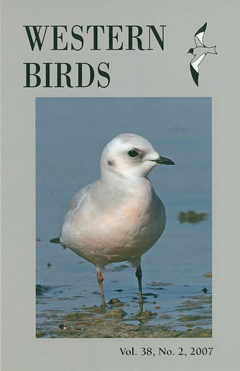
As I cautiously drove west on the north dike to the boat-launch channel, my attention was drawn to a small white gull on the water about 50 feet to my right. My initial reaction was that the gull was a Ross’s Gull (Rhodostethia rosea), but at the same time knew that I was at the south end of the Salton Sea so must be mistaken. However, upon more careful study with binoculars, I was unable to make this bird into an aberrant Bonaparte’s Gull (Larus philadelphia) or an odd looking Little Gull (L. minutus)—it was indeed an adult Ross’s Gull in basic plumage.
At this time the gull flew a short distance to the shore about 100 feet to the northeast and began actively picking insects from the surface of the wet mud.
137-140
STEVEN C. HEINL, ANDREW W. PISTON
The Brandt’s Cormorant (Phalacrocorax penicillatus) breeds along the Pacific coast of North America from Baja California north to south-coastal Alaska (AOU 1998, Wallace and Wallace 1998). In Alaska, it is a rare, local breeder, with nesting documented at only a few locations (Wallace and Wallace 1998). The nearest nesting locations south of Alaska are located on the west coast of Vancouver Island, British Columbia (Campbell et al. 1990).
Although this species has been presumed to winter along the southern coast of Alaska (AOU 1983, AOU 1998, Wallace and Wallace 1998), there have been no formally published mid-winter records for the state. Furthermore, it has been nearly 30 years since this species’ status in Alaska has been summarized (Kessel and Gibson 1978).
Here we present new information on the regular winter occurrence of the Brandt’s Cormorant in the Ketchikan area of southeast Alaska, and we provide a review of its historical occurrence in the state based on published information, including regional reports in American Birds (AB), unpublished information obtained from local observers, and unpublished data archived at the University of Alaska Museum (UAM), Fairbanks.
141-144
MICHAEL T. SCHWITTERS
The Northern Lapwing (Vanellus vanellus) is a common Old World plover that breeds and winters throughout much of Europe. In Asia it breeds south of the tundra regions in a broad band from north of the Caspian Sea east to Mongolia and China. In Russia it breeds generally south of 57° N to the southern trans-Baikal region, the Amur valley, locally in the Pacific region in Ussuriland (Vaurie 1965). It breeds also on Honshu, Japan (Brazil 1991). Eastern Asian populations withdraw south to winter mainly in southern China and north to southern Japan (Vaurie 1965). The birds generally depart their easternmost breeding areas in Russia (Ussuriland) in September (Dement’ev 1969); wintering birds in Japan arrive from late August to October (Brazil 1991).
145-146
ALDEGUNDO GARZA DE LEÓN, SAMUEL LÓPEZ DE AQUINO
In the northern interior state of Coahuila, Mexico, over 400 avian species have been recorded, 46% of which are migrant (Garza de León 2003). Because of its geographic position and topography the area serves as a migration corridor for species from eastern, central, and western North America. These geographic conditions enhance the region’s importance as an area for wintering and transient birds (Garza de León 1987, Garza de León et al. unpubl. data), despite its aridity. Here we report an occurrence of Sabine’s Gull (Xema sabini) in the state of Coahuila.
147-148
Jessie H. Barry
Guides treating specific groups of birds have popped up left and right recently. Tanagers, Cardinals and Finches of the United States and Canada (hereafter Tanagers, Cardinals, and Finches) is one of the first examples in which smaller groups are lumped together and treated in one guide. This aggregation of popular and often brightly colored birds includes many identification challenges, such as redpolls, female-type buntings, and various populations of the Red Crossbill. A critical, modern-style treatment of these subjects would be welcome—is this book it?
149-150
Chris Elphick
Nevadans have long claimed that there is more to their state than a bunch of sagebrush and dirt. And Nevada birders are the same, emphasizing riparian zones filled with warblers and buntings, desert lakes covered with pelicans and grebes, wetlands loaded with avocets and stilts, and montane forests with their woodpeckers, tanagers, and grosbeaks. But, as Ray Nelson’s cover painting for Important Bird Areas of Nevada suggests, what is really important is perhaps all those areas in between—the gray-brown land filled with gray-brown birds: the Ferruginous Hawk, Prairie Falcon, Greater Sage-Grouse, Burrowing Owl, Sage Sparrow, and Sage Thrasher stare out from the cover like a bunch of mobsters on the Las Vegas strip and are deadly serious about the message they intend to send.
151-152
JON L. DUNN, JONATHAN A DERFER
Taxonomic History
Described by Ord in 1825, Wilson’s Snipe (Gallinago delicata) enjoyed the status of a full species through the 4th edition of the AOU Check-list (1931). Then, with the publication of the 20th supplement to its Checklist of North American Birds, the AOU (1945) decided to treat it as conspecific with the Common Snipe (G. gallinago) of the Old World. The reference cited for this change was the treatment in Witherby et al. (1940). In lumping these two taxa, Witherby et al. (1940) relied on the comments made by Meinertzhagen (1924) at a meeting of the British Ornithologists’ Club. Meinertzhagen pointed out that except for the width of the outer tail feathers all of the visual characters known at the time overlapped. Flight-display sounds were not analyzed. Gallinago delicata was not the only species lumped within G. gallinago.
153-156
Dave Krueper
With this issue of Western Birds, I am reinitiating the President’s Message, which is my chance to communicate with you and to promote dialogue between the Western Field Ornithologists’ directors and membership.
I first want to recognize David Yee for his leadership as president over the past three years. Under David’s leadership, we accomplished much, and although at times it might have seemed like herding cats, it has paid off for the directors and the organization as well. Thank you for your persistence, patience, and guidance these past three years, and for your 18 consecutive years of contributions to this organization on our board of directors!
157-157
The 32nd annual meeting of Western Field Ornithologists will be held in Las Vegas, Nevada, 27–30 September 2007, at Sam’s Town Resort and Casino. The local area host for this meeting is the Red Rock Audubon Society. A diverse conference is being planned with half-day and full-day field trips, science sessions, expert panels, workshops, and social activities. The release of the highly anticipated Nevada Breeding Bird Atlas in 2007 will add a special dimension to the meeting. Chris Elphick, editor of The Sibley Guide to Bird Life and Behavior, will give the keynote address.
158-160