PETER PYLE
Mangrove forests are one of the most productive ecosystems in the world. Despite this, over half of the world’s mangroves have been lost through human activities. As suitable habitat declines, mangrove birds are forced into small isolated patches, exposing them to the dynamics of small populations. Our primary objective was to quantify local movement of Mangrove Warblers of the apparently sedentary subspecies Setophaga petechia castaneiceps, endemic to mangroves of Baja California Sur. In 2010, we captured and color-banded 108 breeding adult Mangrove Warblers at 16 sites, then surveyed all surrounding mangroves during the following winter and breeding seasons. We found no movement from one stand of mangroves to another, but we did find territory switching within a stand from winter to the breeding season. The rate of replacement of birds in a territory was high, suggesting that the proportion of floaters is high. We found no significant changes in population density by season or sex.
262-272
LUCAS H. DeCICCO, NILS WARNOCK, JAMES A. JOHNSON
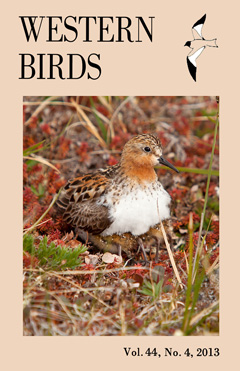
The largely palearctic Red-necked Stint has been documented breeding in the Nearctic Region only in Alaska, from which 12 records were published from 1909 to 1975. In summer 2012 we found a family of Red-necked Stints in the Kigluaik Mountains of the Seward Peninsula, in tundra of the dwarf shrub mat type with ≥50% cover of bare rock. The photographs obtained are the first published of the Red-necked Stint breeding in Alaska.
273-278
JAMES D. BLAND
Sierra Sooty Grouse (Dendragapus fuliginosus sierrrae) are challenging to census because they occur at low densities, are cryptically colored, and live quietly in the forest canopy most of the year. I developed a census method that accounts for several aspects of Sierra Sooty Grouse breeding biology that hinder accurate estimates, including seasonality of singing, anomalous singing by yearling males, low population density, and clumped dispersion of breeding males. Within 167 km² near Pinecrest, Tuolumne County, California, I conducted landscape-scale censuses along a network of line transects from 2006 to 2009 and detected 22 clusters of breeding males (hooting groups). In these used spot-mapping methods to estimate the number of individual males within hooting groups. Territorial display by transient (yearling) males lasted only a few days and became uncommon after 1 May; persistently territorial males became increasingly reluctant to display after mid-May. Thus limiting the census period to 1 May–15 June maximizes detections of persistently territorial males, and a minimum interval of 5 days between repeated censuses minimizes misidentification of transient males as territorial. In the 13 hooting groups that I spot-mapped, the number of persistently territorial males averaged 4.9, and the distance from the center of a territory to the center of the nearest neighboring territory averaged 209 m. The probability of a persistently territorial male being detected on a single census visit averaged 0.71. Three repetitions of the group-scale census within a hooting season were sufficient to detect 98% of persistently territorial males. The density of territorial males was much lower (~0.6 male/km²), and the distribution of males’ territories was much more clumped, than reported in other regions. The number of persistently territorial males was static from 2009 to 2011.
279-293
JAMES D. BLAND
The Mount Pinos Sooty Grouse (Dendragapus fuliginosus howardi) is endemic to south-central California and a species of special concern to the California Department of Fish and Wildlife. Historically, it ranged from Kings Canyon in the southern Sierra Nevada of Fresno County (36° 45' N) south and west to the Mt. Pinos region of Kern and Ventura counties (34° 46.5' N). On the sky islands of Kern and Ventura counties it has not been sighted since 1993. Between 2002 and 2009, I surveyed in all known or potential historic habitat on these sky islands in spring, when males sing. I found no evidence of grouse in that region but did confirm the southernmost breeding sites in the main southern Sierra Nevada. Extirpation from the sky islands appears to have coincided with a proliferation of livestock grazing, timber harvesting, rural development, and fire suppression. Perhaps these activities altered the spatial pattern of seasonal habitats, increasing the grouse’s exposure to predation, or perhaps the removal of large trees, which the grouse uses as territorial songposts, rendered the sky islands unsuitable.
294-308
ROBERT W. DICKERMAN
Dickerman and Johnson (2008) described subspecies Bubo virginianus pinorum of the Great Horned Owl, designating a type specimen from the Sandia Mountains of north-central New Mexico and outlining the range as “plains of the Snake River of Idaho, south ... at increasing elevations, to Arizona and New Mexico.” Bubo v. pinorum is darker dorsally and more heavily barred ventrally than the pale B. v. pallescens of the desert Southwest or B. v. subarcticus of the Canadian prairie parklands but paler and more lightly barred than in B. v. lagophonus or B. v. sturatus to the northwest or in B. v. pacificus of coastal California. Here I trace the distribution of B. v. pinorum further, extending it north and west to central and northern Washington.
309-311
ROBERT W. DICKERMAN
The nesting range of the Black Merlin (Falco columbarius suckleyi), adapted to the temperate rain forest, has been reported as southeast Alaska (Gibson and Kessel 1997), coastal British Columbia (AOU 1957), and adjacent Washington (Wahl et al. 2005). Not all of this distribution has been documented with specimens collected in the nesting season, although some nesting individuals have been trapped and examined in Washington state (C. M. Anderson, fide C. M. White, in litt., 2013). Migrants and wintering birds have been recorded in Oregon (Marshall et al. 2003) and California (AOU 1957). Elsewhere, specimens have been reported from Arizona (Monson and Phillips 1981), New Mexico (Jewett 1944, Friedmann 1950), Colorado (Bailey 1942), Nevada (Alcorn 1943), Idaho (Burleigh 1972, Haak and Sawby 2012), Utah (Behle 1985, Haney and White 1999), Wisconsin (Friedmann 1950), and New Jersey (Capainolo and Pitocchelli 1990).
312-315
MARCELINO MONTIEL-HERRERA, JUAN PABLO GALLO-REYNOSO
The Black Vulture (Coragyps atratus) is a common carrion-eating bird in much of the Americas (Ogada et al. 2012). Studies in North, Central, and South America have described general behaviors such as nesting, bathing, and drinking (McHargue 1981, Stolen 2000, Sazima 2011). But there are few reports of the vocal sounds made by vultures (Blumstein 1990) and no published sonograms. Here we describe some characteristics of the nest of a Black Vulture in Mexico and publish the first sonograms of the vocalizations of two nestings and a juvenile.
316-318
JEFFREY L. LINCER
This is the second edition of a previous work that I’ve always found useful under many conditions. This edition includes 11 new species and contains useful sketches, emphasizing important topographic traits, and exquisite photos, giving the reader an opportunity to see the raptor under a variety of realistic conditions. It is logically arranged, first by taxonomic group, covering all the raptors that breed in North America, and then calling out those with limited ranges in Florida, the Southwest, and Texas. It is a reference that can be useful in one’s library or backpack. It has the kind of detail in which one can enjoyably get lost from the armchair, but its layout, graphics, and text also make it useful in the field. It’s a book for both the experienced raptor biologist and the serious beginner. Although I’ve worked with raptors for almost 4 decades, I still found many interesting facts, revealing perspectives, and identification hints.
319-320
JEFFREY L. LINCER
One of a new series of “ID Guides,” The Crossley Guide: Raptors addresses 34 species. The book is organized into three parts: the first provides computer-assisted images of the raptors, from several angles, in expected habitat/settings, with side-by-side comparisons of the sexes, ages, morphs, and similar species. The photos of each species cover two pages for scarce and localized species or four pages for more common or widespread species. These photos, generally, give the reader an opportunity to see the raptor under a variety of realistic conditions. Some of these plates are in the form of a quiz. The second part consists of species accounts, broken down by overview, flight style, size and structure, plumage, geographic variation, molt, similar species, status and distribution, migrations, and vocalizations. The third part provides the answers to the photo quizzes in the first part.
320-321
CAMERON RUTT
Although the Laysan (Phoebastria immutabilis) and Black-footed Albatrosses (P. nigripes) have been known to hybridize for more than a century, little has been published regarding plumage variation of the hybrid progeny. During six months of field work on Laysan, Hawaii, I noted 13 possible hybrids (five presumed F₁ hybrids, three possible F₂ backrosses with the Black-footed Albatross, and at least four possible F₂ backrosses with the Laysan Albatross). Apparent F₂ backcrosses with the Black-footed Albatross differ from it most noticeably in their black-and-white underwings and much more extensive white circling the face. Apparent F₂ backcrosses with the Laysan Albatross differ from that species most noticeably in their extensive gray smudging throughout the body and darker underwing coverts. Apparent F₂ backcrosses interbreed with the Black-footed Albatross, the first evidence of any hybrid pairing with that parental species.
322-333
PHILIP UNITT
In Western Birds 44(3), Figures 5, 6, and 7 in the article Dark-faced Common Murres of Central California in Fall and Winter (Western Birds 44:250–259, 2013) were inadvertently omitted; they are reproduced here. I apologize for this unfortunate lapse to author Peter Pyle and the readers of Western Birds.
334-335