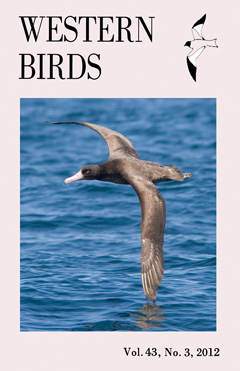
NICK LETHABY, WES FRITZ, PAUL W. COLLINS, PETER GAEDE
Between 2001 and 2011, we made 15 visits during the fall migration period to study bird migration on Santa Barbara Island, off the coast of southern California. We kept daily records of the composition and numbers of migrants, which are summarized in this paper and compared with compiled records of previous sightings from Santa Barbara Island. The area of the island most attractive to migrant land birds is the stand of the shrubs Coreopsis gigantea and Eriogonum giganteum compactum near North Peak. Both overcast skies and Santa Ana winds favor migrants’ reaching the island, whereas northwests winds disfavor it. The island’s isolation, small size, and limited vegetative cover make it an ideal location for observing daily changes in the composition of migrating birds.
118-150
DANIEL S. COOPER, ROBERT A. HAMILTON, SHANNON D. LUCAS
The Cactus Wren (Campylorhynchus brunneicapillus) is a polytypic species widespread in the southwestern U.S. and northern Mexico. Though closer in plumage characteristics to the desert subspecies anthonyi, populations resident in coastal sage scrub and alluvial fan scrub on the coastal slope of Los Angeles County occupy an ecological niche more similar to that of the more southerly subspecies sandiegensis. Because of fragmentation of habitat associated with urbanization, the populations on southern California’s coastal slope are almost entirely isolated from those of the deserts, and apparently from each other. They are declining precipitously for reasons not entirely understood but certainly related to loss, fragmentation, and degradation of suitable habitat. In 2009, we organized a volunteer effort to map the entire population on the coastal slope of Los Angeles County and found 155 active, accessible territories. With the addition of scattered groups believed to occupy inaccessible areas, our maximum estimate for the county is around 200 pairs, most of them in the eastern San Gabriel Valley. We also document the loss of several historical populations in the area and present a revised distribution map for the Los Angeles area indicating connectivity among extant populations.
151-163
OSCAR JOHNSON, BRIAN L. SULLIVAN, GUY McCASKIE
The California Bird Records Committee reached decisions on 244 individuals of 79 species and two species pairs documented since the 35th report (Pyle et al. 2011a), endorsing 170 of them. The Eastern Whip-poor-will (Antrostomus vociferus) was added to the California state list, bringing the total accepted to 644 species, 10 of which are non-native. Notable records of the Ivory Gull (Pagophila eburnea), Black-tailed Gull (Larus crassirostris), and Great-winged Petrel (Pterodroma macroptera) are detailed in this report. At its 2012 annual meeting, the committee removed the Trumpeter Swan (Cygnus buccinator) and Yellow-throated Warbler (Setophaga dominica) from its review list.
164-188
J. DANIEL FARRAR, ADAM A. KOTAICH, DAVID J. LAUTEN, KATHLEEN A. CASTEIN, ELEANOR P. GAINES
On 12 June 2010 Farrar and Kotaich visited a Snowy Plover (Charadrius nivosus) nest at the mouth of Tahkenitch Creek, Douglas County, Oregon. On their arrival at 09:52, they found a female plover with a single chick near the nest site. The uniquely color-banded male was discovered moments later when Kotaich found him on the nest, buried in sand up to his neck (Figure 1). Only his head protruded, with the bill pointing upward. He faced north in the direction of the prevailing winds, the typical incubation posture during windy periods. The weather during the previous several days had included gale-force winds (www.wunderground.com/history/airport/KOTH/2010/6/12/WeeklyHistory.html) strong enough to cause exposed nests to be buried by wind-blown sand.
189-191
JON WINTER
In the late 1960s a group of San Diego field ornithologists gathered regularly to discuss matters of interest in the formation of a new society dedicated to birds and bird issues in California. California Birds later morphed into Western Birds, which now is a widely respected journal circulated world-wide, and the California Field Ornithologists became the Western Field Ornithologists. Cliff Lyons was a founding member of the California Field Ornithologists. During that time it became apparent to Cliff and his contemporaries that the face of field ornithology in California was rapidly changing and records of rare birds were proliferating at an astounding rate. The need for a formal review of such records was clearly apparent. North America’s first committee reviewing records of rare birds was formed by active field ornithologists throughout California in 1970. Cliff was a member of that committee until 1977 and a co-author of the California state list published in the very first issue of California Birds (G. McCaskie, P. Devillers, A. M. Craig, C. R. Lyons, V. P. Couchran, and J. T. Craig, 1970, A checklist of the birds of California, Calif. Birds 1:4–28).
192
JEFF N. DAVIS, LEN BLUMIN
Reports of aberrant plumages and bare-part colors appear now and then on electronic mailing lists and in journals, including this one (Garrett 2001). Typically they pertain to birds with single color aberrations (Collins 2003). Such birds generally are abnormally pale or entirely white, have white spotting, or less frequently are unusually dark (Howell et al. 1992). Occasionally, they are yellow where they should be red or have orange instead of yellow bills, legs, or feet (Bell 2010). Exceptionally, birds display two color abnormalities (Sage 1962). An example was a blackish brown Mew Gull (Larus canus) with white patches scattered over the body and wings (Winter 1985). Here we present photographic documentation of a Mew Gull affected by four color abnormalities, apparently more than have been reported in any bird species.
193-195