WESLEY W. WEATHER, BRENDA J. ZAUN
We used infrared video cameras to obtain the first quantitative measurements of the frequency and details of egg-turning behavior in wild Hawaiian Geese or Nene (Branta sandvicensis). We recorded a total of 240 hr of video, of which 53.8% was at night, over 7 days at two nests in Kilauea Point National Wildlife Refuge, Kauai, Hawaii. The mean of the two females’ daytime egg-turning frequency (1.15 turns/hr) was similar to the value reported for other waterfowl and identical with that of the Canada Goose (Branta canadensis), from which the Nene is thought to be derived. One female turned her eggs less frequently at night, a pattern typical of waterfowl, whereas the other did not. The total number of bouts of egg turning per 24 hr averaged 25.7 for one female and 22.7 for the other. Waterfowl almost always turn their eggs by rotating them solely about the long axis, yet one of these Nene rotated one egg (occasionally two) 180° about the short axis during 21% of egg-turning bouts. We observed a combined total of 65 incubation recesses by the two females, of which 16.8% occurred at night. One of the birds took longer recesses and spent substantially more time away from the nest than the other. As on other Hawaiian islands, the Nene on Kauai tended to take recesses more frequently near dawn and dusk. The two females’ nest attentiveness differed during the daytime but not when averaged over 24 hr.
2-9
KENNETH IRWIN
I describe a new call type (type 10) of the Red Crossbill (Loxia curvirostra complex) associated with Sitka Spruce (Picea sitchensis) in Humboldt County, California. As with other types of the crossbill’s flight calls, the birds using this type of call apparently constitute a subset of the species that is cohesive socially, behaviorally, and morphologically. The patterns of frequency and amplitude modulation of flight calls of type 10 are similar to those of the second half of type 4 but change in frequency more slowly and are given at a higher pitch. The flight calls of type 10 vary among individuals and within an individual’s repertoire, perhaps to a greater extent than in other call types. Most type 10 birds gave toop calls distinctly different from those of all other call types, but a few were similar to those of types 2 and 4. Likewise, the chitter calls of type 10 differed from those of the three call types (2, 3, and 4) found most commonly near type 10. The song repertoires of types 10 and 4 differed as well. Type 10 crossbills are intermediate in size between types 3 and 1. Large numbers of type 10 were resident in Sitka Spruce forests from 2001 to 2010, whereas the few type 4 birds recorded in spruce stands remained only briefly. Morphological and behavioral evidence indicates that type 10 is specialized for foraging on seeds in Sitka Spruce cones.
10-25
D. ARCHIBALD McCALLUM, NATHAN D. PIEPLOW
During the breeding season, phoebes (Sayornis) sing vigorously at dawn with two or three highly stereotyped, probably innate, song types. All song types are combinations of a species-specific introductory note and a terminal phrase. Building on a classic assessment of repertoire structure by W. J. Smith, we recognize three phrase types for the genus (I, II, and III), all of which are used by Say’s Phoebe (S. saya) but only two of which (I and II) are used by the Black (S. nigricans) and another two of which (II and III) are used by the Eastern (S. phoebe) Phoebe. A recently discovered hybrid male Black × Eastern used all three phrase types and sang like Say’s Phoebe by embedding single type II and III songs in longer strings of type I songs. Thus, what appears to be the primitive sequencing of song types was potentiated through reconstitution of the complete repertoire via hybridization. For future studies, we recommend replacement of Smith’s terminology with a simpler scheme recognizing three homologous song types.
26-43
MARY F. WILLSON, KATHERINE M. HOCKER, ROBERT H. ARMSTRONG
The Marbled Murrelet (Brachyramphus marmoratus) ranges from California to the Aleutian Islands, with the center of its abundance in south-central and southeastern Alaska (Piatt and Ford 1993, Nelson 1997). In the conterminous United States, Marbled Murrelets typically nest in old-growth forest on branches in the canopy (Nelson 1997, Piatt et al. 2007). Ground nests of Marbled Murrelets in North America have been known since 1931 (above treeline at 580 m elevation on Chichagof Island in southeastern Alaska), although a ground nest was not well described until 1978 (Carter and Sealy 2005). In British Columbia and Alaska, ground nests occur with increasing frequency to the north and west of the species’ distribution. DeGange (1996) reported 34 nests in Alaska, of which 15 were on the ground; in Southeast Alaska alone, two of six nests were on the ground in forested areas.
44-48
JON L. DUNN, KEITH HANSEN
The Oriental Turtle-Dove (Streptopelia orientalis), also known as the Rufous Turtle-Dove (e.g., Cramp 1985) or the Eastern Turtle-Dove (Goodwin 1983), is a widespread polytypic Asian species that breeds from the Ural Mountains to the Pacific coast of the Russian Far East, including Sakhalin and the Kuril Islands. It also breeds in Japan (south to the Ryukyu Islands) and on Taiwan. It breeds south to west-central Asia, the Indian subcontinent, Myanmar, and northern Indochina. In the Russian Far East its breeding range extends east to the Sea of Okhotsk and as far north as 64° N in the Lena river valley (Wilson and Korovin 2003). Although the species is resident in parts of its range, it vacates the entire northern portion of the breeding range (e.g., all of Russia) in the fall (Wilson and Korovin 2003). These migratory birds winter mostly within the range of residency farther south. Over large portions of northern, central, and western China, the species is only a passage migrant (see range map in Wilson and Korovin 2003).
49-54
The board of Western Field Ornithologists and the editorial team of Western Birds thank the following generous contributors to WFO’s scholarship and publication funds in 2009. At a time when publications of all types are struggling with adaptation to the electronic age, a changing society, and the bust in the economy, the generosity of our members in furthering WFO’s mission is all the more critical and appreciated.
54
KURT A. RADAMAKER, DAVID J. POWELL
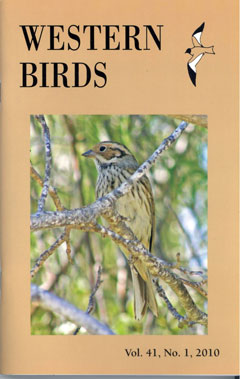
At midday on 8 October 2008, we discovered a Little Bunting (Emberiza pusilla) at Rancho San José de Castro on the Vizcaíno Peninsula, Baja California Sur (cover photo, Figure 1). This sighting represents the first record of this Old World species from Mexico and only the third for North America south of Alaska.
55-58
CHRIS BUTLER
Over the past 20 years, there has been an explosion of interest in the ecology and evolutionary biology of introduced species, particularly birds. The aim of Avian Invasions: The Ecology & Evolution of Exotic Birds is to summarize the current state of knowledge of birds introduced outside their native range. Given the large number of papers that have been published on this topic during the past few decades, this goal is ambitious.
59-60
OSCAR JOHNSON
Birds of the US–Mexico Borderlands: Distribution, Ecology, and Conservation is the latest Studies in Avian Biology from the Cooper Ornithological Society. This volume is an assemblage of the papers presented at the North American Ornithological Conference held in Veracruz, Mexico, on October 2006. It is organized into four sections of two to four papers addressing the topics of changes in distribution and abundance, population trends and ecology of riparian and wetland birds, population trends and ecology of grassland birds, and new technological applications and bird-conservation planning.
60-61
LORI HARGROVE
Although the Black-chinned Sparrow (Spizella atrogularis) is fairly widespread in the Southwest and locally abundant, it is one of the least studied passerines in North America (Tenne 1997). This is perhaps due to its preference for large tracts of undisturbed chaparral or successional scrub in remote and rugged terrain. Over much of its range its population density tends to be low and its occurrence is erratic. The main breeding populations are in southern to central California, Arizona, New Mexico, southern Nevada and Utah, southwestern Texas, and Mexico. Occasional irruptions are reported north as far as Oregon (Gilligan et al. 1994). The Black-chinned Sparrow is a partial migrant, with the distribution shifting southward during winter and into desert scrub mostly in northern to central mainland Mexico and Baja California Sur. As far as known, all populations breeding in the U.S. are migratory, and only a few birds winter in southern Arizona, southern New Mexico, and southwestern Texas. In southern California it is very rare as a winter visitor and as a migrant away from nesting habitat (Unitt 2004). Results of the North American Breeding Bird Survey suggest a national trend of overall decrease in Black-chinned Sparrow abundance of -5.4% per year 1966–2007 (P = 0.001), but many regions of its range are not adequately covered (Sauer et al. 2008).
62-67