NOEL F. R. SNYDER, HELEN A. SNYDER, NARCA MOORE-CRAIG, RICHARD A. WAGNER, ROSE ANN ROWLETT
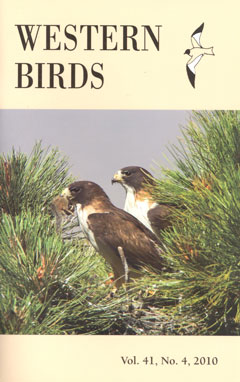
Credible sightings of the Short-tailed Hawk (Buteo brachyurus) in southern Arizona, Sonora, and southwestern Chihuahua commenced in the 1980s and since then have become increasingly numerous throughout the sky islands of Arizona, New Mexico, Sonora, and Chihuahua. In this report we summarize previously unpublished sightings and breeding records from this region and compare aspects of the species’ breeding biology in Arizona and Florida. In 2007 we intensively monitored one successful nest in the Chiricahua Mountains of Arizona—the first fully confirmed nest in the western U.S.—and in 2009 we documented, but did not monitor, another active nest in the Sierra la Madera of Sonora—the first nest known in northwestern Mexico. Like other described nests of the species, both nests were placed near the tops of tall live trees, fully exposed to the sky. Both had broods of two nestlings, the maximum brood size known for the species. Both young fledged from the 2007 nest in the Chiricahuas, matching the productivity of three other probable nestings in the same locality that were documented by sightings of pairs of juveniles in 2003, 2006, and 2010. Together with sightings of single juveniles in 2001, 2004, 2005, 2008, and 2009, these records suggest a very high level of local breeding success. The diet at the 2007 nest was predominantly small birds (83% of 137 identified prey), similar to the diet of the species elsewhere. The majority of Short-tailed Hawks observed so far in the sky islands, including all individuals we have seen (with the exception of one bird in northwestern Chihuahua), have been of the light morph.
202-230
RYAN S. TERRILL, JAMES R. TIETZ, MATTHEW L. BRADY
Interspecific hybrids in the Vireonidae have seldom been reported, and the hybrid combination of the Philadelphia (Vireo philadelphicus) and Red-eyed (Vireo olivaceus) Vireos has been reported only twice before. We here report an apparent hybrid that remained on Southeast Farallon Island 7–13 September 2008. Its breast color, head pattern, head shape, and measurements were intermediate between those of the Philadelphia and North American subspecies of the Red-eyed. Details of the wing structure eliminated the Warbling (Vireo gilvus) and South American subspecies of the Red-eyed as possible parental species.
231-239
PETER A. GAEDLE, DAVID KISNER, HUGH RANSON
The Northern Goshawk (Accipiter gentilis) is extremely rare and apparently irregular as a breeding species in southern California. Nesting has been confirmed only 13 times, twice at Mt. Abel, Kern County (1989 and 1990), five times at Mt. Pinos, Kern/Ventura counties (1904, 1960, 1989, 1990, and 2009), once in Ventura County (1919), once in the San Bernardino Mts., San Bernardino County (2004), three in the Cuyamaca Mts., San Diego County (1937–1938), and once at Big Pine Mtn., Santa Barbara County (2009). The nest at Big Pine Mt. was notable only in being the first for Santa Barbara Co. but in being built in an exposed situation in a dead burned tree in partially burned forest.
240-246
MICHELLE L. KISSLING, STEPHEN B. LEWIS, DANIEL A. CUSHING
We studied the diet of the Western Screech-Owl (Megascops kennicottii) at the northern edge of its range, in southeast Alaska. To describe the diet in the breeding season we collected pellets from beneath roost trees or nest cavities of 10 radio-marked owls, their mates, and their young. Mammals found in 46 of 48 groups of pellets, 98%) and invertebrates (81%) were the most frequently taken prey, birds (23%) the least. We tallied 115 mammalian and 25 invertebrate prey items (all insects). Mammalian prey was either rodents (Cricetidae) or shrews. To eliminate bias associated with pellet analysis and to describe the diet during the nonbreeding season, we analyzed stomach contents of 15 owl carcasses salvaged from September to February. Insects (47 of 57 prey items; 82%), particularly beetles and caterpillars dominated the contents of these stomachs numerically; mammals constituted only 5 of 57 items (9%). Thus in southeast Alaska Western Screech-Owls feed to a large extent on small mammals, primarily deer mice (Peromyscus), and supplement their diet with insects, especially in the winter.
247-255
MARY F. WILLSON, KATHERINE M. HOOCKER
We report a possible hostile takeover of a female (and a territory) by a male American Dipper (Cinclus mexicanus) near Juneau in southeastern Alaska in 2006. The evidence is circumstantial but strongly suggestive, in light of previous studies.
Infanticide by unrelated conspecific individuals, both male and female, is widespread among mammals (Hrdy 1979) and birds (Chek and Robertson 1991, Møller 2004, Veiga 2004). Usurping males kill existing offspring, quickly making the bereft female ready to mate again (e.g., Hrdy 1979, Freed 1986, 1987). In passerine birds, infanticide by adult males occurs in a variety of species (e.g., swallows, wrens, sunbirds, starlings; Møller 1988, Freed 1986, 1987, Kermott et al. 1990, Goldstein et al. 1986, Robertson and Stutchbury 1988, Smith et al. 1996), often giving the usurper a mate or sometimes both a mate and a nest (Hansell 2000). Infanticide by a usurping male at a given nest may be spread over more than one day (Goldstein et al. 1986, Kermott et al. 1990, Yeager 1990).
256-257
DENISE WIGHT
Situated in northern California, Contra Costa County is one of nine counties that make up the San Francisco Bay Area. It extends from San Francisco Bay north to the San Joaquin Delta and east to the western edge of the Central Valley. Located in the heart of the county is Mount Diablo, a major geographic feature and focal point. These diverse regions contribute to the avian richness of the county, which supports habitats for such nesting species as the Black Oystercatcher, Swainson’s Hawk, and probably the Black Rail. Additional breeding birds of conservation concern include the Tricolored Blackbird, Yellow-billed Magpie, and Least Tern. In size, Contra Costa County ranks 48th among California’s 58 counties, but as of 2008, it was the ninth most populated, with over a million people.
258-259
PHILIP UNITT, DAVID E. QUADY
In 1987, Western Field Ornithologists instituted the Alan M. Craig Award, to be given “on an irregular basis for exceptional service to the organization.” After considerable discussion last year, WFO’s board of directors decided to resurrect this award and to set about seeking and evaluating nominees.
260
PETER PYLE, BRIAN SULLIVAN
The currency of bird records committees has been “records,” but the definition of a record is not as simple as it may seem. Does a flock of 17 Hudsonian Godwits (Limosa haemastica) in Oregon constitute 1 or 17 records? What about a Thick-billed Kingbird (Tyrannus crassirostris) that returns winter after winter but is gone each spring, or a Neotropic Cormorant (Phalacrocorax brasilianus) that occurs off and on at the same location for years but is absent for months at a time? Multiple records at different locations, furthermore, might or might not consist of repeated sightings of the same individual. It is these sorts of scenarios that have led the California Bird Records Committee (CBRC 2007) and others to focus more on individual birds than
261-265