GARY W. PAGE, LYNNE E. STENZEL
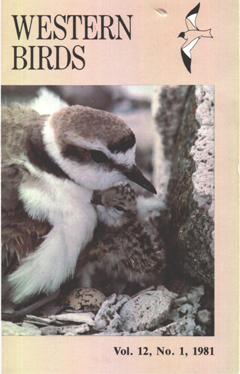
The western race of the Snowy Plover (Charadrius alexandrinus nivosus) breeds on the Pacific coast from southern Washington to southern Baja California, inland in Oregon, California, Nevada, Utah, Colorado, New Mexico, Kansas, Oklahoma and Texas, and along the coasts of Texas and northeastern Mexico (AOU 1957). For many years ornithologists believed that the number of Snowy Plovers breeding along the Pacific coast was declining as development destroyed suitable habitat. In May, June and July, from 1977 to 1980, Point Reyes Bird Observatory (PRBO) biologists and volunteers conducted surveys of potential breeding habitat throughout California to gather information on the distribution and abundance of Snowy Plovers. This paper summarizes the results of those surveys and the available data on the species’ past abundance and distribution. We attempt to define suitable breeding habitat and to describe the effects of human activities on it. Detailed studies of marked birds undertaken by John and Jane Warriner at Pajaro Dunes on Monterey Bay have been very helpful in interpreting the survey results. Their information on migration periods, mid-breeding season movements and the detection rate of birds on censuses is summarized in this paper. Detailed information on the occurrence of birds at specific sites is available in a report (Page and Stenzel 1979) on file with the California Department of Fish and Game in Sacramento. If readers have information indicating greater breeding numbers or know of breeding sites not mentioned here, we and the Department of Fish and Game encourage them to contact us.
1-40
JOHN T. RATTI
For nearly 100 years ornithologists have considered the genus Aechmophorus to include only one species, the Western Grebe (A. occidentalis). Few ornithologists, especially amateur field ornithologists, have been aware that the Western Grebe has been considered polymorphic, with two distinct phenotypes referred to as dark and light phases (Storer 1965, Mayr and Short 1970).
Recent study of sympatric dark-phase and light-phase populations indicates the polymorphism classification is erroneous and that the forms function as separate species (Ratti 1979). Additional data are needed on dark-phase and light-phase birds, and hopefully this paper will aid in alerting both professional and amateur ornithologists to the identification and distribution of these species.
41-46
JON E. SWENSON
Ospreys (Pandion haliaetus) readily colonize suitable habitat created by manmade impoundments. Henny et al. (1978a) found that about 47 percent of the Ospreys in Oregon, and a greater percentage of those in the interior of the state, nest along reservoirs. In northern California, about 20 percent of the Ospreys nest along reservoirs, including 49 percent in the interior of the region (Henny et al. 1978b). Henny et al. (1978a,b) suspected that Osprey numbers had increased in both areas due to the construction of the reservoirs. Also, Henny and Noltemeier (1975) and Henny et al. (1978b) have described situations where Ospreys or their progeny, nesting on natural lakes, have colonized nearby reservoirs as nest sites became less available at the natural lakes. Childress and Eng (1979) documented an increased Osprey population with the construction of shallow impoundments in an existing reservoir. However, the establishment of a breeding Osprey population in an area where breeding Ospreys were not previously found has apparently not been documented. This paper documents such a situation.
47-52
CARROLL D. LITTLEFIELD
On 22 May 1976 Caryn Talbot and I watched a Gray-headed Junco (Junco caniceps) for about 20 minutes as it fed among willows (Salix sp.) 3.2 km NE of Malheur National Wildlife Refuge (NWR) Headquarters, Harney County, Oregon. The bird was seen clearly several times within 6 m, under excellent lighting conditions. This not only represented the first refuge record, but also the first Oregon record.
The individual was slightly larger than the Dark-eyed Junco (J. hyemalis oreganus) and had ash gray coloration on the head, sides and upper breast, contrasting with white underparts. The lores and ocular region was blackish, and the white rectrices were obvious. The rusty back was observed clearly several times at close range. Collecting was impossible at this site. I am familiar with all species of juncos in North America, and have spent time observing and studying Gray-headed Juncos in Colorado, west Texas and southeastern Arizona.
53-53
LINDEN A. PIEST, LYLE K. SOWLS
For a long time the American Wigeon (Anas americana) has been known to be a common migrant and winter resident in Arizona. Evidence of wigeons breeding in the state, however, has been inconclusive. Although they are occasionally observed during summer in the high-elevation lakes of eastern and northern Arizona, we can find no reference to prove that wigeons nest there. Mearns (1890) shot “a number” at Mormon Lake (Coconino County) in late May 1887, and believed they were breeding there, although he found no nests. Phillips et al. (1964) wrote that the only recent breeding record was for Ashurst Lake (Coconino County) in 1929. No details were provided to verify these statements. Probably as a result of these records, Bent (1923) considered the wigeon to be “probably breeding” in northern Arizona and the AOU (1957) listed it as a rare breeder in northern Arizona.
These records, and observations of wigeons breeding in New Mexico (Huey and Travis 1961, Ligon 1961), leave little doubt that they have bred in Arizona but breeding has been poorly documented due to limited waterfowl investigations in this state.
54-54
Terrell Rich
On 1 June 1980 at 1115 I discovered a male Golden-winged Warbler (Vermivora chrysoptera) in my neighbor’s yard in Shoshone, Lincoln Co., Idaho. Its song first drew my attention—a familiar song after my many years of birding in Wisconsin where this warbler is a common spring migrant. I studied the warbler for about an hour as it foraged in deciduous trees. It continued to sing in bouts of 4-7 songs roughly every 15 minutes. Several times the warbler came within 2 m permitting unmistakable identification with the unaided eye. I also watched it through 15x binoculars and obtained the following description: Plumage: crown, bright yellow; eyeline extending through the eye, black; chin and throat, black; back grayish; wingbars, broad, deep yellow; underparts, grayish white.
55-55
ASA C. THORESEN
The southern extent of the known breeding range of the Horned Puffin is Forrester Island, Alaska. They have not yet been found breeding in British Columbia. However, in 1973 Sealy and Wilson (Syesis 6:51-55) reported that Horned Puffins (Fratercula corniculata) were becoming a regular winter and spring visitant to the coasts of British Columbia. Later, Hoffman, Elliott and Scott (Western Birds 6:87-94, 1975) reported that the species had been sighted along the Oregon and California coasts in May, June and July.
56-56