STANLEY SENNER, BRIAN TAVERNIA, MONICA IGLECIA, BETHANY CHAGNON, LARRY NEEL
Stillwater National Wildlife Refuge and Carson Lake and Pasture are the key components of the Lahontan Valley wetlands, designated in 1988 as a site of hemispheric importance in the Western Hemisphere Shorebird Reserve Network. In 1990, Congress authorized transfer of Carson Lake and Pasture from federal ownership to the state of Nevada, provided that the area be managed consistent with its designation as part of the network. To enhance protection and management of the site, and specifically to inform development of a management plan for Carson Lake and Pasture, we analyzed spring and fall surveys for shorebirds, 1986–2019, archived by the Nevada Department of Wildlife. Over the 34 years of surveys, we
documented 28 species, 19 of which occurred in ≥50% of the years surveyed. Annual counts of all shorebirds combined exceeded 100,000 in 24% of the survey years and 20,000 in 94%. Annual counts of the American Avocet (Recurvirostra americana) exceeded 10% (45,000 individuals) of the estimated global population in three years, and of the Long-billed Dowitcher (Limnodromus scolopaceus; 50,000 individuals) in two years. On the basis of their numbers and frequency of occurrence or status as species of national conservation concern, we identified these two species plus nine others as priorities for management. We recommend conducting more consistent surveys and identifying specific opportunities to manage water quantity and quality, vegetation, livestock grazing, or other factors to benefit shorebirds.
94-111
AllISON M. ROTH, JENNIFER M. GEE, CARL N. KEISER
Most birds living in the temperate zones breed in spring or summer. in a variety of species, however, copulatory behavior has been observed out of season in autumn. such activity has been proposed to represent late breeding attempts, help to maintain pair bonds during the nonbreeding season, or aid in the formation of future breeding pairs. We observed three attempted copulations (one with cloacal contact) in late november between three male and two female California Quail (Callipepla californica), a species with a flexible mating system. Given that one of the females, and at least two of the observed males, were under a year of age and, therefore, almost certainly sexually immature, we suggest that these copulation attempts could contribute to pair formation. the two males and two females, whose identities were known, spent more time associating with the individual with which they engaged in copulatory activity than with any other covey member of the opposite sex, also implying a social function of this behavior. nevertheless, we cannot rule out the unlikely possibilities that the observed activity represented astonishingly early breeding attempts, acted as expressions of intersexual social dominance, or functioned as practice for the upcoming breeding season. Possibly, the behavior served no immediate adaptive purpose. nevertheless, autumn copulatory activity in the California Quail may be more common than known, and we present these observations as a call for further monitoring to clarify the potential function(s) of this behavior.
112-123
GARY H. ROSENBERG, KURT RADAMAKER
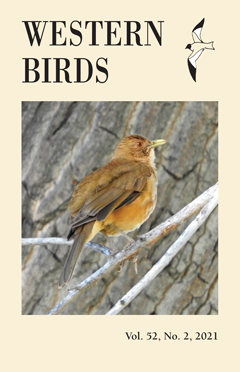
From 2018 to 2020 the Arizona Bird Committee reviewed 195 reports and updated the Arizona bird list through 2020, adding two species—the White-throated Thrush (Turdus assimilis) and Clay-colored Thrush (Turdus grayi)— bringing the Arizona state list to 567 species in good standing.
124-147
LUCAS H. DeCICCO
I report observations, supported by museum voucher specimens, photographs, and audio recordings, from an area of breeding contact between two divergent groups of subspecies of the Fox Sparrow (Passerella iliaca) in upper Cook Inlet, south-central Alaska. In this area, covering ~50 km2, the interior iliaca group comes in contact with the Pacific coast unalaschcensis group in lowland mixed boreal forest. Phenotypically pure P. i. zaboria and P. i. sinuosa (subspecies representing the iliaca and unalaschcensis groups, respectively) occur in approximately equal abundances and outnumber intermediate phenotypes. These subspecies co-occur on a fine scale, males of zaboria and sinuosa often holding adjacent territories. I conclude that some form of pre- or post-zygotic isolating mechanism between these two subspecies-groups is hindering free interbreeding
148-159
JACK J. WITHROW, MICHAEL LENZE
On 29 September 2020, while crane hunting near Delta Junction, Alaska (64° 02ʹ N, 145° 44ʹ W), Lenze took a Hooded Crane (Grus monacha) when it landed among decoys with a flock of 70+ Sandhill Cranes (Antigone canadensis). The bird had been in the vicinity for several days, but its exact arrival date is unknown. The specimen (University of Alaska Museum 45000) was a male weighing 3300 g, with light fat; it appeared to be in good health. We inferred that the bird was in its second year (~15 months old) from its adult-like head and neck plumage, unlike that of first fall juveniles, which do not have a black crown/forehead patch (Figure 1). The relatively worn, brownish remiges that are uniformly shorter than one replaced secondary on the right wing (Figure 2) represent juvenal feathers (i.e., first generation). The replaced secondary 5 and other feathers appeared too new to have gone through a year’s wear and had likely been replaced as part of the second prebasic molt before the bird started its southward migration. The tail had two retained juvenal feathers (faded and shorter than the rest) on the right side, and there were at least two generations of feathers in the wing coverts (Figure 2). The details of molt in cranes, the Hooded Crane being no exception, are not well understood (see Howell 2010
160-164
W. ROSS SILCOCK
It has been generally accepted that the type specimen of the Slate-colored Fox Sparrow (Passerella iliaca schistacea Baird, 1858), preserved in the U.S. National Museum of Natural History as USNM A 5718, was collected 19 July 1856 in southwestern Nebraska (AOU 1910, 1931, 1957, Deignan 1961). Questions regarding the locality of collection persist, however, primarily because it is in short-grass prairie (Kaul and Rolfsmeier 1983) some 370 km east of the nearest known sites of breeding in the Medicine Bow Mountains of southeastern Wyoming (Faulkner 2010; www.eBird.org, species map accessed January 2021). The stage of molt of the adult female specimen (Swarth 1920, Pyle 1997) suggests a date later than mid-July or a different collection location. Mid-July significantly precedes the Fox Sparrow’s usual time of fall migration in September and October. There have been no records documented by specimen or photograph of this taxon in Nebraska in the ensuing 160+ years (Silcock and Jorgensen 2020); the nearest such records are along the Front Range of eastern Colorado during migration (eBird.org, accessed January 2021). Finally, questions have been raised (Swarth 1920, Goetzmann 1959, Moore 1986, Wright 2019) about the accuracy of the record as presented by Baird et al. (1858). Here I address these questions in more detail.
165-167
TONATIUH GAONA-MELO, GONZALO DE LEÓN-GIRÓN, GORGONIO RUIZ-CAMPOS, IRAK RODRÍGUEZ-HERNÁNDEZ, PHILIP UNITT
During surveys (January 2018–November 2020) for the Northern Saw-whet Owl (Aegolius acadicus) in the Parque Nacional Sierra de San Pedro Mártir, Gaona-Melo collected one individual of this species at the site known as La Capilla (31.011 ° N,–115.534 ° W, elevation 2336 meters above sea level) on 18 June 2020 (Figure 1). The specimen, a juvenile male measuring 190 mm in total length, 430 mm in wing span, 140 mm in wing chord, 76 g in weight (Figure 2), was taken by mist net at 21:36 during sampling for nocturnal raptors in a riparian stand of Quaking Aspen (Populus tremuloides) adjacent to mixed coniferous forest comprising Jeffrey Pine (Pinus jeffreyi), White Fir (Abies concolor), and Sugar Pine (Pinus lambertiana). The right testis measured 3.1 × 1.8 mm, the left 3.4 × 1.4 mm. This individual represents the first known specimen of this species in Baja California (Anthony 1893, Grinnell 1928, Wilbur 1987, Erickson et al. 2020). Furthermore, the age of the bird strongly suggests local nesting, being the first such evidence for Baja California
168-172
GARY M. SANTOLO
Nesting by grebes of any species on a solid nonfloating surface, such as the ground, rocks, or a concrete structure, is very rare and has been reported in only five
species: the least Grebe (Tachybaptus dominicus; Hayes 2018), Great Crested Grebe (Podiceps cristatus; Simmons 1955, Ulfvens 1988), Horned Grebe (Podiceps auritus;
Fjeldså 1973), and Western Grebe (Aechmophorus occidentalis) and Clark’s Grebe (A. clarkii; Nero et al. 1958, Nero 1959). In the latter two species such nests are considered rare (riensche et al. 2009, laPorte et al. 2013). For example, Hayes et al. (pers. comm.) observed no active nests on land during a ten-year study of 32,234 nests of the Western and Clark’s Grebes at Clear lake, lake County, California, although a few with abandoned eggs were stranded by receding water levels. Here I report on Aechmophorus grebes nesting on the ground in a wetland in southern California.
173-177
Graham Chisholm
It was on a flight over the Primorye, a Russian province formerly part of Manchuria, abutting North Korea and China, that Jonathan Slaght recalls falling in love with the Russian Far East, and particularly Primorye. Straddling the Sea of Japan it is a mysterious mountainous Russian province that during the Soviet era was off limits to foreigners for military reasons, and the exotic wild home of the Amur Tiger and Amur Leopard.
178-279
David L. Pearson
Many books consist of a collection of essays. Here I review a set of essays that could well have been assembled in a book but were instead published in Colorado Birds, the quarterly journal of the Colorado Field Ornithologists. For ten years, from 2010 to 2019, one of that organization’s prominent members, David Leatherman, wrote a regular column titled “The Hungry Bird,” whose stated goal was to provide uncommon background deepening insight into bird observations. He did this by using his experience as an entomologist and professional field biologist to better understand birds through their behavior, what they eat, and who eats them.
178-182
Clayton Taylor
Catherine Waters of the Western Field Ornithologists called me to ask if I would review a book on bird photography, and specifically if I thought it was of suitable content for an average birder. As any experienced tour leader can attest, birders and bird photographers share a love of birds, but the similarities end there. Upon seeing an interesting bird, the birder will watch it, maybe make notes, snap a few photos, and move on to find the “next one.” Bird photographers want to stay there, continuing to photograph the bird until it leaves or they have recorded the best possible images that the bird and the scene will allow them. That is why many of the birding tour companies are now running tours dedicated to bird photographers.
181-182
JODHAN FINE, RAYMOND L. VANBUSKIRK, JACK B. PARLAPIANO, MATTHEW J. BAUMANN
on 2 october 2020, tony B. Godfrey alerted the new Mexico birding community about an interesting plover of the genus Pluvialis at Maxwell national Wildlife Refuge, colfax county, northern new Mexico (36° 34′ 15″ n, 104° 34′ 54″ W, elevation 1840 m). the refuge is located in an open basin enclosed from the west by the sangre de cristo Mountains and from the east by high, scattered mesas. the refuge contains 3699 acres of playa lakes, short-grass prairie, woodlots, and crop fields. this plover had apparently been photographed by another birder at the same location several days earlier, on 28 september, but it was originally reported as a Black-bellied Plover (Pluvialis squatarola) via www.eBird.org and therefore wasn’t flagged for attention by that site’s reviewers for the date and location. Photos from 28 september were not submitted until many days after the observer’s initial report. the series of photos taken by Godfrey on 2 october displayed pale underwings and bright white axillaries, the latter unique among the species of Pluvialis to the european Golden-Plover (P. apricaria; see this issue’s outside back cover). in addition to the white axillaries, the thin bill, bright golden plumage, and short primary projection further supported the identification and eliminated both the Black-bellied Plover and american GoldenPlover (P. dominica). the last Pluvialis considered was the Pacific Golden-Plover (P. fulva), which is phenotypically similar and has a history of vagrancy, including to inland locations in the western united states. For example, there are four accepted records from arizona, three from utah, and one from idaho (Rosenberg et al. 2017, https://ibrc.idahobirds.net/rare-bird-reports/3-a-03-pacific-golden-plover, http://www.utahbirds.org/Reccom/RareBirdsindex.html). the Pacific and european Golden-Plovers both have similarly short primary projections, but the smaller bill, shorter legs, more prominent white bases to the inner primaries, and especially the
white axillaries and underwing coverts are diagnostic field marks of the european Golden-Plover. Given that the latitude of Maxwell national Wildlife Refuge (~36° n), similar to that of the southernmost portion of the european Golden-Plover’s winter range, it is plausible that the Maxwell plover could have survived the winter on the refuge. however, on 26 october, exactly four weeks after the bird was originally found, a strong cold front moved through the state, bringing temperatures of nearly –18° c and substantial snow. the plover was not seen after this date, and it is unknown whether it was killed or pushed to a more suitable location.
183-187