P. K. YOCHEM, J. R. JEHL, JR., B. S. STEWART, S. THOMPSON, L. NEEL
Conover (1983) reported on breeding populations of the California Gull (Larus californicus) in the western United States and found that the total number of nesting birds in the 1980s had nearly tripled from that in the 1920s (276,000 vs. 101,000). The species’ status in Nevada is not well documented, even though rookeries are restricted to a few localities in the western part of that state. For example, Power (1980) presented low and high estimates for the number of breeding adults of 1800 and 7512, respectively, whereas surveys conducted by U.S. Fish and Wildlife Service (USFWS) and Nevada Department of Wildlife (NDOW) biologists during the late 1980s suggest there may be more than 15,000.
1-12
JOHN H. HARRIS
Alteration and loss of riparian habitat have played a central role in the decline of riparian bird species (Gaines 1974, Remsen 1978, Laymon et al. 1987). However, the absence of certain species from seemingly suitable habitat (Gaines 1974) suggests that other factors may also be important. In his review of the historical riparian avifauna of the Sacramento Valley, Gaines (1974) suggested that 9 of 12 of the declining species, including the Willow Flycatcher (Empidonax traillii), were susceptible to and had probably been adversely affected by Brown-headed Cowbird (Molothrus ater) brood parasitism.
13-26
EDUARDO PALACIOS, LUCIA ALFARO
Coastal lagoons, with their adjacent beaches, salt marshes, and mudflats, are important habitats for numerous birds, including terns and shorebirds. These habitats are used by both migratory and resident species, the former including not only those present during the winter, but also those that reproduce in the area. The future of these habitats is threatened by the ever-increasing impacts of residential and recreational development. In California, two of the bird species that have been most directly affected by the loss or reduction of these habitats are the Snowy Plover (Charadrius alexandrinus nivosus) and the California Least Tern (Sterna antillarum browni). In Baja California, coastal lagoons harbor important breeding populations of these species, but, even here, the colonies are being directly affected by the off-road vehicles and pets of tourists. As indicated by Atwood (1987), their habitat, besides these individual species, should be considered endangered. Accordingly, it is important to inventory the present extent and utilization of these habitats before additional plans to develop them are approved and carried out. We present here a survey of the breeding birds of two such coastal wetlands, Laguna Figueroa and La Pinta Pond, Baja California.
27-32
LUIS SANTAELLA
On 29 April 1990, at 1500, while on a 73-foot motor yacht cruising the eastern Pacific Ocean at 19°26'N, 110°44'W (approximately 6 nautical miles north of San Benedicto Island, the northernmost of the Revillagigedo Islands of Mexico), Santaella spotted a large albatross about 200 meters from the boat. He immediately pointed out the bird to his companions, all experienced observers: Andrés and Pilar Sada, Eugenio Clariond, Miguel A. Gomez, Barbara M. Montes, and Mario A. Ramos. Having just seen two Laysan Albatrosses (Diomedea immutabilis), he initially thought that the approaching bird would be another Laysan. When clearly seen, however, the bird was unmistakably an adult Short-tailed Albatross (Diomedea albatrus). We all saw the bird well with binoculars for about three minutes as it flew north low over the water in a leisurely but purposeful manner and disappeared into the distance. The weather was fair with light wind and swell and an air temperature of 78°F.
33-34
TERRY A. SCHULZ
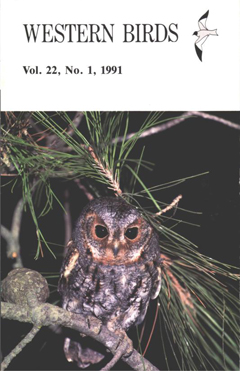
Information on the migration of the Flammulated Owl (Otus flammeolus) in California is minimal (Bloom 1983, Winter 1974, Collins et al. 1986). This paucity of data is perhaps due to the species’ strictly nocturnal habits and its habit of not calling during the fall, making detection very difficult (Winter 1974). The Flammulated Owl is found mainly in the Transition Zone of California, most often in forests of Ponderosa Pine (Pinus ponderosa), Sugar Pine (Pinus lambertiana), Douglas Fir (Pseudotsuga menziesii), White Fir (Abies concolor), Incense Cedar (Calocedrus decurrens), and Black Oak (Quercus kelloggii) (Winter 1974, 1979, Marcot and Hill 1980). The Flammulated Owl is almost exclusively insectivorous (Marshall 1957, Ross 1969, Goggans 1985) but rarely takes small vertebrates (Johnsgard 1988).
35-36
MICHAEL A. PATTEN, KURT RADAMAKER
In the early morning of 22 September 1990 we, along with Thomas E. Wurster, observed a Sharp-tailed Sparrow (Ammodramus caudacutus) at Furnace Creek Ranch, Death Valley National Monument, Inyo County, California. It was seen feeding in the weeds and resting in the scrubby tamarisks surrounding a small pond in the northwestern corner of the golf course. The lack of wind and the warm and clear conditions allowed us to study the bird closely through binoculars for 20 minutes.
37-38
NEAL D. NIEMUTH
On 10 June 1990, Ken and Phil Luepke, Keith Merkel, and I observed a Golden Eagle (Aquila chrysaetos) nest on an unused center-pivot irrigation system in central Albany County, approximately 39 km north of Laramie, Wyoming. One adult was at the nest, which was occupied by one unfledged juvenile.
39-39