JERI M. LANGHAM
Western Field Ornithologists and the California Bird Records Committee are again pleased to thank Bushnell, a division of Bausch & Lomb, for its continued generous support in helping to sponsor the publication of these reports.
This report contains 244 reviewed records of 70 species plus one hybrid. The 206 accepted records of 58 species and 38 unaccepted records of 25 species plus one hybrid represent an 84.8% acceptance rate.
The California Bird Records Committee (hereafter, the CBRC or the Committee) is very grateful to the 183 observers who took time to contribute descriptions and/or photographs of birds on our Review List that they encountered in California. Although this report includes records from more observers than any previous report, we still encourage additional birders and ornithologists to support the CBRC process by submitting reports and/or photographs to Michael A. Patten, CBRC Secretary, P.O. Box 8612, Riverside, CA 92515. The Western Foundation of Vertebrate Zoology (1100 Glendon Avenue, Los Angeles, CA 90024) and its director Lloyd Kiff continue to maintain the archive of all records published in CBRC reports. All voice recordings are kept at the California Academy of Sciences, Department of Ornithology and Mammalogy, Golden Gate Park, San Francisco, CA 94118.
97-130
MICHAEL A. PATTEN, BRIAN E. DANIELS
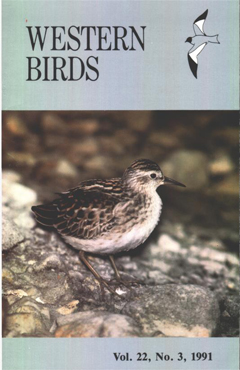
On 29 August 1988 we, along with Douglas R. Willick and Kurt Radamaker, identified a juvenile Long-toed Stint (Calidris subminuta) at the sewage ponds in Salinas, Monterey County, California. At about 1230 PDT, Daniels noticed an unfamiliar small Calidris sandpiper sitting at the edge of one of the large rock-lined sewage ponds with some Least (C. minutilla) and Western Sandpipers (C. mauri); he and Willick watched it for about 20 minutes before Patten and Radamaker arrived. The weather was clear and mild with a slight breeze, so observation conditions were excellent. We studied the bird through binoculars and telescopes for the remainder of the afternoon at distances as close as 20 feet.
131-138
SCOTT GROTHE
At 1147 hrs, on 20 April 1990, at a distance of 50 to 75 m, I observed a male Garganey (Anas querquedula) on the Snake River, approximately 15 km west of Hammett, Idaho, 200 m east of the Flying “H” irrigation pump station. I watched the bird for about 2.5 minutes. The Garganey was feeding within a floating bed of algae along the bank with a male and female Cinnamon Teal (A. cyanoptera). From 1815 to 1833 hrs on 2 May 1990, and again at 0800 on 3 May, I saw the bird at a distance of 20 to 40 m, feeding in a similar fashion with a male and female Cinnamon Teal, now 50 m west of the Flying “H” irrigation pump station on the north side of the river. At approximately 1600 hrs on the same day, D. M. Taylor and N. Cummings observed the male Garganey at this same location displaying the same feeding behavior.
139-140
RICARDO RODRIGUEZ-ESTRELLA, GUSTAVO ARNAUD, SERGIO ALVAREZ CARDENAS
Socorro Island, the largest and biologically most diverse of the four islands of the Revillagigedo Archipelago (Brattstrom 1990), confronts serious problems related to human activities. Eight endemic taxa of land birds now breed on Socorro: Yellow-crowned Night Heron, Nyctanassa violacea gravirostris; Socorro Red-tailed Hawk, Buteo jamaicensis socorroensis; Socorro Ground Dove, Columbina passerina socorroensis; Green Parakeet, Aratinga holochlora brevipes; Socorro Wren, Thryomanes sissonii; Socorro Mockingbird, Mimodes graysoni; Tropical Parula Warbler, Parula pitiayumi graysoni; and Socorro Towhee, Pipilo erythrophthalmus socorroensis (McLellan 1926, Jehl and Parkes 1982, Brattstrom 1990). Jehl and Parkes (1983) have proposed that domestic cats (Felis catus), introduced since 1957, are responsible for the extirpation of the endemic Socorro Dove, Zenaida graysoni, and reductions of other species, especially the Socorro Mockingbird. However, no quantitative data on predation by feral cats on Socorro Island have been previously reported in the literature. We present here an analysis of the diet of feral cats on Socorro Island.
141-143
Peter Gent
You may have noticed that issues of Western Birds have recently been appearing quite frequently. WFO hopes and expects that all issues of Volume 22 will appear during 1991, so that the journal will be caught up by the end of the year. Then from 1992 and Volume 23 onward, four issues will come out in the correct calendar year. This also means that the renewal notices for Volume 23 will be sent out in early 1992. Please renew promptly even though it will be less than a year since you last renewed.
144-144