DANIEL D. GIBSON, LUCAS H. DeCICCO, ROBERT E. GILL JR., STEVEN C. HEINL, AARON J. LANG, THEODORE G. TOBISH JR., JACK J. WITHROW
The fourth report of the Alaska Checklist Committee outlines 22 species and two subspecies added to the Checklist of Alaska Birds during the five years 2013–2017, resulting in a net total of 521 species and 119 additional subspecies of birds recognized as occurring or having occurred naturally in Alaska through 2017.
174-191
DEMEI OTOBED, ALAN R. OLSEN, MILANG EBERDONG, HEATHER KETEBENGANG, MANDY T. ETPISON, H. DOUGLAS PRATT, GLENN H. McKINLAY, GARY J. WILES, ERIC A. VANDERWERF, MARK O’BRIEN, RON LEIDICH, UMAI BASILIUS, YALAP YALAP
After compiling a historical list of 158 species of birds known to occur in Palau, the Palau Bird Records Committee accepted 10 first records of new occurrences of bird species: the Common Pochard (Aythya ferina), Black-faced Spoonbill (Platalea minor), Chinese Pond Heron (Ardeola bacchus), White-breasted Waterhen (Amaurornis phoenicurus), Eurasian Curlew (Numenius arquata), Gull-billed Tern (Gelochelidon nilotica), Channel-billed Cuckoo (Scythrops novaehollandiae), Ruddy Kingfisher (Halcyon coromanda), Common Kingfisher (Alcedo atthis), and Isabelline Wheatear (Oenanthe isabellina). These additions bring Palau’s total list of accepted species to 168. We report Palau’s second records of the Broad-billed Sandpiper (Calidris falcinellus), Chestnut-winged Cuckoo (Clamator coromandus), Channel-billed Cuckoo, White-throated Needletail (Hirundapus caudacutus) and Oriental Reed Warbler (Acrocephalus orientalis). This report concludes with a current list of the bird species known from Palau.
192-205
JOSEPH J. FONTAINE, KARIE L. DECKER
We describe a noninvasive modification to the technique of branch-clipping for sampling arthropods and evaluate its efficacy for studying food resources for a foliage-gleaning warbler breeding in the sky islands of southern Arizona. In the foliage-area method, arthropod abundance is measured on individual branches, and search area is controlled for by estimating surface area with a shadowed grid, analogous to canopy cover being estimated with a densiometer. Our technique enables repeated sampling of the same branch, which can limit sampling error and facilitates detailed studies of phenology across seasons and over multiple years. Overall it required less effort than traditional approaches, but because of the logistical challenges associated with sampling tree canopies, it is best suited for studies of species that forage relatively low to the ground. The foliage-area method does not alter the habitat, making it ideally suited for studies in protected areas, when foliage is limiting, or for work with food crops or endangered plant species.
206-213
CAROLYN GUNN, KEVIN J. AAGAARD, KIM M. POTTER, JASON P. BEASON
Most published accounts of the Northern Black Swift (Cypseloides niger borealis) contain disagreements and inaccuracies concerning the species’ sexual dimorphism in plumage. These reports represent small sample sizes and are not based on birds recaptured and followed over time. In our study, to gain a better understanding of dimorphic plumage characteristics, we captured swifts at four breeding colonies in the Rocky Mountains from 2004 through 2017. We banded breeding adults, recorded eight metrics (wing chord, flat wing, length of the outermost [r5] and innermost [r1] rectrices, the difference in these lengths, length of white tipping on the abdomen and undertail coverts, and weight), and photographed the birds’ underparts. We followed these characteristics in birds recaptured for up to 13 years. The difference in the mean depth of the tail fork (r5 – r1) was the most definitive plumage characteristic distinguishing the sexes of adults, being accurate in 95% of the birds examined. With few exceptions, males had only slight white tipping of the abdominal feathers and undertail coverts, whereas females had significantly longer white tipping on those feathers. Individuals that were recaptured did not change appreciably over time in wing chord, depth of tail fork, or degree of white tipping on the abdomen and undertail coverts. This is the largest and longest study of sexual dimorphism in the Northern Black Swift and clarifies previous misinterpretations of these characteristics.
214-225
GARY H. ROSENBERG, PAUL E. LEHMAN, AARON J. LANG, VICTOR RUBEN STOLL
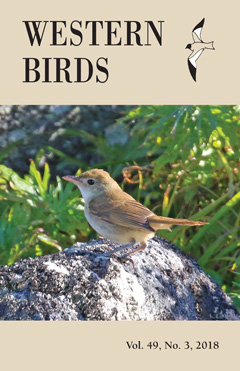
n the evening on 8 September 2017, in the “far boneyard” at Gambell, St. Lawrence Island, Alaska (63.78° N, 171.74° W), Victor and Ruben Stoll flushed a passerine they could not immediately identify. The “boneyards” are large pits excavated by the resident Yupik Natives seeking buried ivory and artifacts, a result of several thousand years of sea-mammal hunting from this island’s Northwest Cape. Working these pits turns the soil, which has resulted in the growth of relatively lush vegetation consisting of two species of Artemisia, known locally as “wormwood.” The combination of lush vegetation (reaching 0.5–1 m in height) and deep depressions that offer protection from the wind is attractive to migrant and vagrant landbirds in the otherwise flat, gravelly landscape. Soon thereafter, we, along with Greg Scyphers, Monte Taylor, and other birders then at Gambell, converged at the far boneyard in search of the bird. It was soon relocated and seen on the ground briefly by Lang, who suggested it was a Thick-billed Warbler (Iduna aedon), a bird he was familiar with from southeastern Asia and a species not previously recorded in Alaska or North America. Plumage features of this bird included brown upperparts, warm reddish-brown rump and tail, and pale underparts. Lang noticed that it had a very plain gray (“blank looking”) face, lacking any noticeable eye-line or pale supercilium. It also appeared to be relatively large bodied, and long tailed. These features eliminated any other Old World warbler previously recorded in North America. The bird was flushed several more times that evening but proved difficult to see and photograph well.
226-230
DAVID VANDER PLUYM, LAUREN B. HARTER
The Common Grackle (Quiscalus quiscula) is common in eastern North America, and since the 1970s has steadily spread west. It now breeds as far west as eastern British Columbia and central New Mexico, and records of vagrants elsewhere in the West have increased (Peer and Bollinger 1997, Jaramillo and Burke 1999). Northern populations are migratory, Great Lakes populations moving 1000 km on average (Dolbeer 1982). In this note, we document the first record of the Common Grackle for Sonora and summarize the status of the species in Mexico.
231-233
MARK BERTRAM, ADAM GRIMM
On 30 May, 31 May, and 1 June 2017 we observed a melanistic Horned Grebe (Podiceps auritus) at Canvasback Lake (66° 23.13’ N, 146° 23.18’ W) on the Yukon Flats National Wildlife Refuge, situated in eastern interior Alaska, 185 km north of Fairbanks. We photographed it, accompanied by a smaller Horned Grebe in normal breeding plumage, on 30 and 31 May (see this issue’s outside back cover). At midday on 30 May the melanistic grebe responded to our playing a recorded call of a territorial male by assertively approaching and greeting the normally plumaged grebe, its likely mate. The melanistic bird remained with that grebe throughout our playing of the call.
234-235