STEVEN G. MLODINOW, TONY LEUKERING, TAYLER BROOKS, NICK MOORE
In external appearance, a confounding Picoides woodpecker encountered in Lamar, Prowers County, Colorado, on 15 May 2014 was closest to the Downy Woodpecker (P. pubescens), though its bill appeared oversized and its supercilium narrow. But its vocalizations closely resembled those of the Hairy Woodpecker (P. villosus). Examination of photographs and sound spectrograms of this individual strongly suggest that it was a hybrid between the Downy and Hairy Woodpeckers, a previously unreported combination.
2-7
MARTIN MEYERS
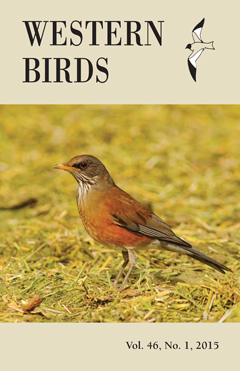
This report covers the 115 records reviewed by the Nevada Bird Records Committee in 2013, of which 105 were endorsed. These 115 records cover sightings from 15 August 1954 through 15 September 2013. Four species are added to the Nevada list as a result of endorsed first state records, the Common Crane (Grus grus), Slaty-backed Gull (Larus schistisagus), Barred Owl (Strix varia), and Rufous-backed Robin (Turdus rufopalliatus). Also, one species is added as a result of the taxonomic split of the Sage Sparrow. Two species are removed from the Nevada list, the Allen’s Hummingbird (Selasphorus sasin) and Pine Warbler (Setophaga pinus). The Nevada state list now stands at 492 species, of which 156 are currently on the review list.
8-27
JACK J. WITHROW
Isolated in the western Gulf of Alaska 61 km from nearest land and 74 km southwest of the Kodiak archipelago, Chirikof Island has never seen a focused investigation of its avifauna. Annotated status and abundance for 89 species recorded during eight visits 2008–2014 presented here include eastern range extensions for three Beringian subspecies of the Pacific Wren (Troglodytes pacificus semidiensis), Song Sparrow (Melospiza melodia sanaka), and Gray-crowned Rosy-Finch (Leucosticte tephrocotis griseonucha). A paucity of breeding bird species is thought to be a result of the long history of the presence of introduced cattle and introduced foxes (Vulpes lagopus), both of which persist to this day.
28-48
HARRY R. CARTER, MICHAEL W. PARKER, JOSH S. KOEPKE, DARRELL L. WHITWORTH
In August 2012, we confirmed breeding by an estimated 50 pairs of Ashy Storm-Petrels (Oceanodroma homochroa) at four nearshore rocks (Franklin Smith Rock, Wharf Rocks, Casket Rock, and Stillwell Point Rock) along the central coast of Mendocino County, California. Nesting in this region at the northern end of the species’ range was first discovered in 1926, when four eggs were collected by Franklin J. Smith on nearshore rocks and preserved in private collections but not published. Ashy Storm-Petrel colonies were not detected north of Marin County during major surveys of seabird colonies in 1969, 1979–1980, or 1989, but specific efforts to detect storm-petrels were made at only a few rocks. In 2012, we did not find Ashy Storm-Petrels breeding north of Stillwell Point Rock (39.3° N), which appears to be the current northern limit of the species’ breeding range.
49-65
ROBERT W. DICKERMAN
The winter of 1996–1997 saw a major invasion of New Mexico by “winter” finches, particularly the Evening Grosbeak (Coccothraustes vespertinus) and Cassin’s Finch (Haemorhous cassinii, until 2012 known as Carpodacus cassinii). This event was well documented at Albuquerque (Bernalillo Co.) and Española (Rio Arriba and Santa Fe counties). Concomitant with this invasion, perhaps because of it, there was an epizootic of salmonellosis and mortality of finches that included as well the House Finch (H. mexicanus) and, to a lesser extent, the Red Crossbill (Loxia curvirostra).
66-68
ROBERT W. DICKERMAN
The Long-eared Owl (Asio otus) is almost cosmopolitan in the North Temperate Zone. In Eurasia (see Peters 1940, Vaurie 1965), A. o. otus (Linnaeus, 1758) is found throughout the range of the species, except for the Canary Islands, where isolated A. o. canariensis Madarász, 1901, occurs. In North America two wide-ranging subspecies have been named, distinguished by size and color. “Eastern” A. o. wilsonianus (Lesson, 1830; type locality Pennsylvania) is reportedly larger and darker; “western” A. o. tuftsi Godfrey, 1948 (type locality South Arm, Last Mountain Lake, Saskatchewan) is reportedly smaller and paler (Godfrey 1948). The latter form was recognized by the AOU (1957), Monson and Phillips (1981), Marks et al. (1994), and Pyle (1997). Browning and Cross (1999) suggested the existence of even a third, as yet unnamed subspecies (see Marshall et al. 2006). But tuftsi was maintained as a junior synonym of wilsonianus by Rea (1983) and Unitt (1984). Rea (1983:171) wrote that “males are considerably darker than females” (n = 30) and questioned the validity of a paler western race. Kenneth C. Parkes “compared western birds of various museum ages … with topotypical Pennsylvania material and was unable to substantiate a western race” (loc. cit.). Parkes “doubted the validity of … ‘tuftsi’ … and suggested the supposed differences were artifacts of individual variation and museum age of specimens” (Unitt 1984:110).
68-70
NICHOLAS R. HAJDUKOVICH, LUCAS H. DeCICCO, PAVEL S. TOMKOVICH
THE BAR-TAILED GODWIT (LIMOSA LAPPONICA) BREEDS DISCONTINUOUSLY ACROSS A VAST EXPANSE OF TUNDRA FROM ALASKA WEST TO SCANDINAVIA AND SPENDS THE NONBREEDING SEASON IN COASTAL AREAS OF THE EASTERN HEMISPHERE FROM NEW ZEALAND TO WESTERN AFRICA (CRAMP AND SIMMONS 1983, HIGGINS AND DAVIES 1996). RECENT AUTHORITIES RECOGNIZE THREE TO FIVE SUBSPECIES OF THE BAR-TAILED GODWIT (HIGGINS AND DAVIES 1996, PIERSMA ET AL. 1996, ENGELMOER AND ROSELAAR 1998, DICKINSON 2003, CLEMENTS ET AL. 2013, DICKINSON AND REMSEN 2013). HERE WE FOLLOW DICKINSON AND REMSEN (2013) IN RECOGNIZING FIVE SUBSPECIES (LISTED FROM WEST TO EAST BY BREEDING DISTRIBUTION): L. L. LAPPONICA (LINNAEUS, 1758; TYPE LOCALITY SWEDISH LAPLAND), L. L. TAYMYRENSIS ENGELMOER AND ROSELAAR, 1998 (NEAR LAKE TAYMYR, CENTRAL SIBERIA), L. L. MENZBIERI PORTENKO, 1936 (INDIGIRKA RIVER DELTA, EASTERN SIBERIA), L. L. ANADYRENSIS ENGELMOER AND ROSELAAR, 1998 (MARKOVO, RUSSIAN FAR EAST), AND L. L. BAUERI NAUMANN, 1836 (NORFOLK ISLAND, TASMAN SEA). THESE DIFFER IN SIZE (E.G., BILL AND WING LENGTH; PORTENKO 1936, HIGGINS AND DAVIES 1996, ENGELMOER AND ROSELAAR 1998, TOMKOVICH 2010) AND PLUMAGE (E.G., EXTENT OF VENTRAL RED FEATHERING IN BREEDING PLUMAGE AND EXTENT OF RED BREEDING FEATHERS ON THE MANTLE AND SCAPULARS; RYNN 1982). HOWEVER, GIVEN THE DIFFICULTIES IN DISTINGUISHING SUBTLE DIFFERENCES AMONG THESE CHARACTERISTICS IN THE FIELD, WE FOCUS ON THE MORE DISCERNIBLE VARIATION OF THE RUMP, LOWER BACK, AND AXILLARIES (CRAMP AND SIMMONS 1983, ENGELMOER AND ROSELAAR 1998, MCCAFFERY AND GILL 2001, TOMKOVICH 2010). AT THE WESTERN END OF THE SPECIES’ BREEDING DISTRIBUTION—FROM FENNOSCANDIA TO THE KANIN PENINSULA IN RUSSIA—NOMINATE LAPPONICA SHOWS AN UNPATTERNED WHITE RUMP AND LOWER BACK WITH A FEW DARK THIN STREAKS (THE RUMP CONTRASTING GREATLY WITH THE DARK OF THE REST OF THE DORSAL SURFACE) AND AXILLARIES WITH MINIMAL DARK BARRING (NIEBOER ET AL. 1985, HIGGINS AND DAVIES 1996, ENGELMOER AND ROSELAAR 1998). AT THE OTHER EXTREME, THE ALASKA-BREEDING SUBSPECIES BAUERI HAS A UNIFORMLY DARK DORSUM, INCLUDING THE RUMP AND LOWER BACK, AND AXILLARIES EXTENSIVELY BARRED DARK (HIGGINS AND DAVIES 1996, ENGELMOER AND ROSELAAR 1998, TOMKOVICH 2010). SUBSPECIES MENZBIERI, TAYMYRENSIS, AND ANADYRENSIS REPRESENT STEPS OF CLINAL VARIATION IN PLUMAGE BETWEEN LAPPONICA AND BAUERI, MOST NOTABLY IN THE RUMP AND LOWER BACK (FIGURE 1; ENGELMOER AND ROSELAAR 1998, TOMKOVICH 2010). SUBSPECIFIC LIMITS OF THE POPULATIONS OF SIBERIA AND THE RUSSIAN FAR EAST ARE IN NEED OF FURTHER STUDY AND CLARIFICATION (MCCAFFERY AND GILL 2001, MLODINOW AND AANERUD 2006, TOMKOVICH 2008, 2010).
71-75
JEFFREY E. LOVICH
Wind-energy development is proceeding rapidly worldwide, including in the United States. Yet we still know rather little about the direct and indirect (Katzner et al. 2013) environmental effects of renewable-energy development and operation (Hernandez et al. 2014), especially the negative effects on wildlife (Lovich and Ennen 2011, 2013). Birds and bats are particularly sensitive (Kuvlesky et al. 2007) through collisions with turbines and other equipment (Cohn 2008). Loss et al. (2013) suggested that 140,000–328,000 birds are killed annually by monopole turbines in the United States. On the basis of an installed capacity of 51,630 MW of energy in 2012, Smallwood (2013) estimated the annual fatality in the United States at 888,000 bats and 573,000 birds, including 83,000 raptors.
76-80
JACKSON D. SHEDD
During the summer Acorn Woodpeckers (Melanerpes formicivorus) have been observed to subsist on foods other than stored dried acorns (MacRoberts 1970), and reasons for this seasonal dietary shift correlate strongly with the need of the young for high-protein food (Koenig et al. 2008). This species has been documented to consume a variety of foods in addition to acorns, including sap (MacRoberts 1970), oak catkins, fruit, annual grains (MacRoberts and MacRoberts 1976), insects (Bent 1939, MacRoberts 1970, Koenig et al. 2008), and the eggs of both conspecifics (Mumme et al. 1983) and other birds (Bryant 1921, Fajer et al. 1987). In addition to enumerating the aforementioned dietary items, MacRoberts (1970) commented that he did observe one Acorn Woodpecker consume a lizard, “probably Sceloporus occidentalis” (the Western Fence Lizard), along the central coast of California. Although the Western Fence Lizard may have been the most likely lizard species at that particular study site, the identification was not confirmed. Furthermore, MacRoberts remarked “whether the lizard was alive or dead when it came into the woodpecker’s possession is unknown.”
81-82
DAVID VANDER PLUYM
The northern California coastline covered by this guide stretches 800 miles from the southern end of Monterey County north to the Oregon border. This region has a wealth of scenic coastlines, large estuaries, towering redwoods, world-renowned birding hotspots such as Monterey Bay and Point Reyes, and a wealth of bird life. It is also a contrast in terms of urban areas with everything from the urban sprawl of the San Francisco Bay area to Humboldt/Mendocino’s Lost Coast, a stretch of coastline over 60 miles long without roads.
83-86
JON FEENSTRA
There is a subliminal draw to things that we believe are scarce and/or difficult to obtain, observe, or experience, and birders are often intoxicated by this chase. This book’s cover photo of a breeding-plumaged Spoon-billed Sandpiper, arguably one of the world’s most recognizable and charismatic critically endangered birds, is nicely chosen to grab the reader’s attention. Within, the text details the great conservation efforts that are keeping some the world’s most endangered bird species from extinction, as well as a few of the ones that didn’t make it.
86-87
The board of Western Field Ornithologists and the editorial team of Western Birds thank the following generous contributors who gave to WFO’s publication, scholarship, and general funds in 2014. The generosity of our members in sustaining WFO is an inspiration to us all.
88
ANTHONY J. BRAKE
Tool use has been demonstrated in a number of avian species (Lefebvre et al. 2002). Perhaps the best-known example is the Woodpecker Finch (Camarhynchus pallidus) of the Galápagos Islands, which breaks off cactus spines or twigs for use in extracting wood-boring insects (Eibl-Eibesfeldt 1961, Eibl-Eibesfeldt and Sielman 1962, Tebbich et al. 2002). New Caledonian Crows (Corvus moneduloides) display exceptional skill in selecting, manufacturing, and utilizing objects to obtain food items that they are otherwise unable to reach (Hunt 1996). In North America, Brown-headed Nuthatches (Sitta pusilla) have been observed to use flakes of pine bark to remove other pieces of bark in order to capture insects underneath (Morse 1968, Pranty 1995). All of the above behaviors are considered true tool use in that they involve a tool being held directly by the beak or foot of the bird (Lefebvre et al. 2002). Numerous woodpecker species have been observed to use “anvils” such as tree forks or crevices into which food items are wedged to facilitate consumption (Bondo et al. 2008). Most such cases represent proto-anvils consisting of natural crevices. Great Spotted Woodpeckers (Dendrocopos major), however, use “true anvils” that they excavate in tree trunks. Here we report observations of a Williamson’s Sapsucker (Sphyrapicus thyroideus) using a wood flake for foraging.
89-91