KENNETH P. ABLE, ALAN BARRON, JON L. DUNN, KEVIN E. OMLAND, LARRY SANSONE
The circumpolar Common Eider (Somateria mollissima) has six or seven recognized subspecies, females of which differ in size, overall coloration, and bill characters. An adult female observed 20–29 November 2011 in the harbor at Crescent City, Del Norte County, California, was apparently not the Pacific subspecies, S. m. v-nigrum (Pacific Eider). We analyzed photographs, published information, and specimens, and the Crescent City bird’s intensely rufous plumage as well as qualitative and quantitative bill morphology, especially the distance from the tip of the frontal lobe to the proximal end of the nares divided by total bill length, indicated that it was an example of S. m. dresseri (American or Atlantic Eider), of the northwest Atlantic Ocean.
90-99
SCOTT P. CROSBIE, LEVI E. SOUZA, HOLLY B. ERNEST
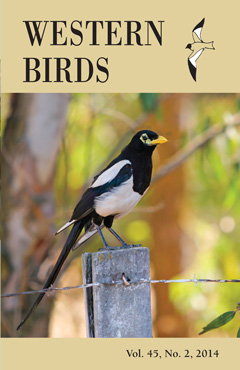
In 2007 and 2008, we evaluated the distribution of the Yellow-billed Magpie (Pica nuttalli) and estimated habitat-specific densities and abundances with point-transect surveys. We found possible contractions since the mid-20th century, with reductions from Fresno south to Bakersfield, in the Sacramento delta, and in southern portions of the Coast Ranges of central California. Over the species’ entire range, its population density was 6.1 birds/km² and approximately 4.0 × 10⁵ birds (percent coefficient of variation [%CV] 13.1%). Density was greatest in agricultural habitats (8.2 birds/km², 17.4% CV) and least in urban habitats (1.3 birds/km², 36.9% CV). Abundance was greatest in rural habitats (2.5 × 10⁵ birds, 17.0% CV) and least in urban habitats (5.3 × 10³ birds). Further monitoring of temporal trends in the abundance of this bird endemic to central California and studies of its population genetics, habitat usage, and demography are warranted.
100-111
RYAN P. O’DONNELL, STEVE CARR, CRAIG FOSDICK, ROBERT BOND, RICK FRIDELL, STEVE HEDGES, COLBY NEUMAN, RON RYEL, TERRY SADLER, JACK J. SKALICKY, MARK STACKHOUSE, MERRILL WEBB
This 19th published report of the Utah Bird Records Committee summarizes 160 records of 71 species reported between 15 June 2010 and 31 December 2012. The committee accepted 134 records. Noteworthy records include four species new to the Utah state list, the Purple Sandpiper (Calidris maritima), Gilded Flicker (Colaptes chrysoides), Tropical Kingbird (Tyrannus melancholicus), and Pyrrhuloxia (Cardinalis sinuatus), which bring the state list to 450 species; the state’s second Roseate Spoonbill (Platalea ajaja), Pomarine Jaeger (Stercorarius pomarinus), Curve-billed Thrasher (Toxostoma curvirostre), Canyon Towhee (Melozone fusca), and Northern Cardinal (Cardinalis cardinalis); second, third, and fourth Iceland Gulls (Larus glaucoides); third Prairie Warbler (Setophaga discolor) and Baltimore Oriole (Icterus galbula); and third and fourth Philadelphia Vireos (Vireo philadelphicus). The Cackling Goose (Branta hutchinsii) was removed from the state review list in January 2012 because sufficient documented sightings confirm it is a regular winter visitor to Utah.
112-131
EUGENE S. HUNN, DAVID BEAUDETTE
White-crowned Sparrows (Zonotrichia leucophrys pugetensis) breed throughout the lowlands of western Washington, but before 1953 there was just one record of this subspecies east of the Cascade Range. Over the last 35 years, however, because of logging and development, pugetensis has spread and now occurs at and east of the Cascade crest, with definite evidence of nesting by 1988 on the eastern slopes of the Cascades. Gambel’s White-crowned Sparrow (Z. l. gambelii) was first recorded nesting in the Cascades of northern Washington in 1957. Beaudette confirmed its nesting in the central Washington Cascades at Naches and Stevens passes in 1994 and 1996, when he observed singing males of both pugetensis and gambelii in close proximity to each other. In 2006 Hunn recorded songs of both subspecies in such a situation near Naches Pass. More recent reports extend the area of apparent sympatry south to White Pass in Yakima County and east of the Cascade crest in Kittitas and Yakima counties. The situation suggests that the White-crowned Sparrow as now defined might include two (or more) species.
132-140
KEVIN B. CLARK, BETH PROCSAL, MARK DODERO
We observed a Yellow-billed Cuckoo (Coccyzus americanus) remaining in southern San Diego County from 20 to 28 July 2012. The bird made extensive use of upland habitats as well as the adjacent riparian area. Away from the two known breeding populations, the 82 Yellow-billed Cuckoo observations in southern California since 2000 peak from 15 June to 3 July. Observations made later in summer likely consisted of migrants perhaps in poor condition, lingering individuals prospecting for breeding habitat, or possibly scattered breeding pairs. Eight locations have had multiple occurrences since 2000, and these sites may support breeding birds. Though a relatively large number of cuckoos was detected in the region in 2011, no trend is apparent in numbers of detections since 2000. Annual variation in cuckoo numbers regressed on El Niño–Southern Oscillation climate data produced a strongly predictive model (r² = 0.54, P = 0.004). Given the Yellow-billed Cuckoo’s urgent conservation needs in the western United States in general, and in California in particular, focused attention is needed, including systematic surveys to determine if there are additional breeding pairs in the region.
141-150
BRENDA J. ZAUN, JOSEPH R. BARNETT, CHRISTA D. WEISE, LINDEN A. PIEST
The Peregrine Falcon (Falco peregrinus) is found almost worldwide, but few have been documented nesting in southwestern Arizona or southeastern California. Here we report on Peregrine Falcon nests discovered at two locations, both suspected in 2012 and confirmed in 2013. One is the first documented Peregrine Falcon nest on the lower Colorado River south of Parker, Arizona, and a first record for Imperial County, California (Guy McCaskie, California Bird Records Committee, pers. comm.), and the other is the first recorded for Yuma County, Arizona, at Kofa National Wildlife Refuge (NWR). The eyrie along the Colorado River was more easily accessible than the Kofa eyrie, so we observed it at a much closer range, enabling recording of more detailed information, and we were able to visit it more frequently, two to six times per month from March through September.
151-153
Robert A. Hamilton
When David Sibley first released his concept of a bird guide into the wild at the turn of the century, Jon Dunn and colleagues had already demonstrated how a formidable team of experts working under the auspices of a first-rate organization, the National Geographic Society, could outshine even the legendary suite of talents of a Roger Tory Peterson. Featuring the work of numerous talented artists and including all of the rarities that drive so many birders to go birding in the first place, the National Geographic guide seemed invincible. The upstart Sibley Guide to Birds represented one inspired person’s singular vision of what a field guide should look like and the topics it should cover, and, shockingly, it just said “no” to all those fancy strays from abroad. The layout, with its family/group accounts, flight silhouettes, in-flight depictions of each species, and extensive depictions of seasonal and geographic variation, as well as hybrids, was unlike any other North American guide. The artwork was distinctive and instantly recognizable, incorporating Sibley’s refined eye for structure and detail only where it needed to be. As everyone now knows, there was more than enough room for both approaches. In the 14 years that have passed, Sibley has kept himself busy putting out two regional bird guides, books on birding basics and bird behavior, a birding app (now being updated to the new standard), and even a well-received guide to the trees of North America, all while maintaining a useful and eclectic web site (www.sibleyguides.com
154-157
Lauren B. Harter
World-famous for its spectacular scenery and rich geologic history, the Grand Canyon is not generally regarded as a birding destination. Nonetheless, the Grand Canyon region has produced some remarkable bird records, most notably of a White Wagtail, as well as the only Arizona records of the Common Redpoll and White-winged Crossbill. With the reintroduction of the California Condor in 1996 and the more recent advent of sharing sightings through www.eBird.org
157-159
OSCAR JOHNSON, MARK J. BILLINGS
The Yellow Warbler (Setophaga petechia) comprises three groups of subspecies distributed across the Americas, from Alaska and northern Canada south through the West Indies and the mainland of Middle America to the northern coast of South America and the Galapagos Islands. The groups differ primarily in the head pattern of adult males (Lowther et al. 1999). The Northern Yellow Warbler (S. p. aestiva group) comprises the predominantly migratory subspecies with a green and/or yellow crown that breed across much of the United States, Canada, and northern and central Mexico; the Golden Yellow Warbler (S. p. petechia group) comprises the largely resident subspecies, most with a chestnut crown, found in south Florida, the Caribbean, and the coast of northeastern South America; and the Mangrove Yellow Warbler (S. p. erithachorides group) comprises the largely resident subspecies, most with a fully chestnut head, found in coastal mangroves from extreme southern Texas and central Baja California south as far as the coast of northwestern South America, with an isolated population on the Galapagos Islands that resembles the Golden Yellow Warbler in the extent of red on the head (Lowther et al. 1999). Although currently considered one species (AOU 1998), each of the three subspecies groups has been considered a full species by some authors (Hellmayr 1935).
160-166