KEVIN S. FOERSTER, CHARLES T. COLLINS
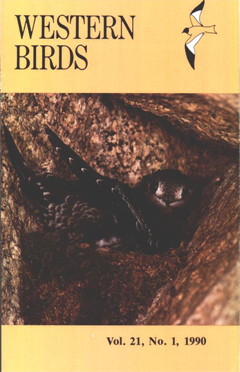
The Black Swift (Cypseloides niger) is sparsely distributed over wide portions of western North America from British Columbia and southwestern Alberta south to southern California and east to Colorado (A.O.U. 1983). Elsewhere its range includes Mexico, Central America south to Costa Rica, and the Greater Antilles. Within this range, it has a discontinuous distribution, with nests found on sea cliffs (Vrooman 1901), in sea caves (Legg 1956), behind mountain waterfalls (Smith 1928, Knorr 1962), on moist inland cliffs (Michael 1927), and in limestone caves (Davis 1964). The winter range of the migratory population in western North America is presumed to be southern Mexico (Friedmann et al. 1950).
1-10
PAUL L. NOBLE
From March 1986 through June 1987 I censused owls 72 km south of San Francisco in the northern end of Monte Bello Open Space Preserve, in Santa Clara County. My objectives were to identify the species and determine the density of owls in various habitats. Vocal responses to tape-recorded calls were noted and compared to weather conditions, lunar phases, and time of year.
11-16
ALLAN R. PHILLIPS
Various studies in recent years have advanced our knowledge of the identification of Gavia adamsii, the Yellow-billed Loon or White-billed Diver, and its winter distribution in North America. Still, only breeding adults are readily distinguishable (with care) from the more widespread G. immer, the Common Loon or Great Northern Diver.
17-24
RICHARD E. WEBSTER, JOSEPH MORLAN, DON ROBERSON
At about 1500 on Monday, 27 September 1982, Webster was birding at the San Diego River mouth, San Diego County, California. He was standing on the south side of the flood control channel, viewing the flats through a 15–25× spotting scope, when he noted an unusual tern about 50 yards away. It flew with steady, rowing wingbeats, rising and falling a bit on every stroke, as it headed into the stiff breeze coming off the ocean. After a rainy morning, the sun was out, though winds were still gusting to 20 miles per hour
25-32
DANIEL A. STEPHENS, CHERYL WEBB, CHARLES H. TROST
The A.O.U. Checklist (1983) listed the Lesser Goldfinch (Carduelis psaltria) as casual or accidental in southwestern British Columbia, eastern Oregon, and southern Wyoming. It was not listed for Idaho by Burleigh (1972) and was reported without details as a rare spring migrant at the Minidoka National Wildlife Refuge, southern Idaho, by Larrison et al. (1967). Before 1988 there were only eight Lesser Goldfinch records for Idaho, all from southern counties (Bannock, Canyon, Elmore, Minidoka, and Twin Falls). For a review of seven of these records see Taylor and Trost (1987). An additional record not reported by Taylor and Trost is of one observed by Jeff Marks on Simco Road 0.2 mi. north of Highway 67, in Elmore County on 18 September 1982 (pers. comm.).
33-34
ALAN A. GUBANICH, HOWARD R. PANIK
The Bushtit (Psaltriparus minimus) is evidently not a common host of the Brown-headed Cowbird (Molothrus ater). Only eight instances of cowbird parasitism on this species have been reported (Bent 1946, Friedmann 1963, Friedmann 1966, Friedmann et al. 1977, Smith and Atkins 1979, Friedmann and Kiff 1985). One involved the subspecies P. m. californicus, the other seven, P. m. minimus. Here we report the first known instance of cowbird parasitism on the subspecies P. m. plumbeus, the Lead-colored Bushtit, and an observation of adult Lead-colored Bushtits feeding a fledgling Brown-headed Cowbird.
35-36
CLIFFORD M. ANDERSON, DAVID M. BATCHELDER
The range of the Black-shouldered Kite (Elanus caeruleus) in the United States has been described as restricted to southern Texas, California (west of the desert and the Sierra Nevada), Florida, Louisiana, and Oklahoma (rare) (American Ornithologists’ Union 1957). The species has been expanding its range during the last 30 years, however (Eisenmann 1971, Larson 1980), and has now been reported in at least 22 states (American Ornithologists’ Union 1983, Clark and Wheeler 1987, Toups et al. 1985).
37-38
CLARK S. WINCHELL
On 22 April 1989 I observed an adult and chick Snowy Plover (Charadrius alexandrinus) standing within 10 cm of each other at West Cove at San Clemente Island. I found the birds at 2355 hr by spotlight while surveying the intertidal zone and observed them for 2 minutes from a distance of 15 m. The adult then took flight, leaving the chick, which I subsequently captured and examined for 3 minutes. I took no measurements, but from its feather development I estimated the chick would not fledge for at least 1 or 2 weeks.
39-40